
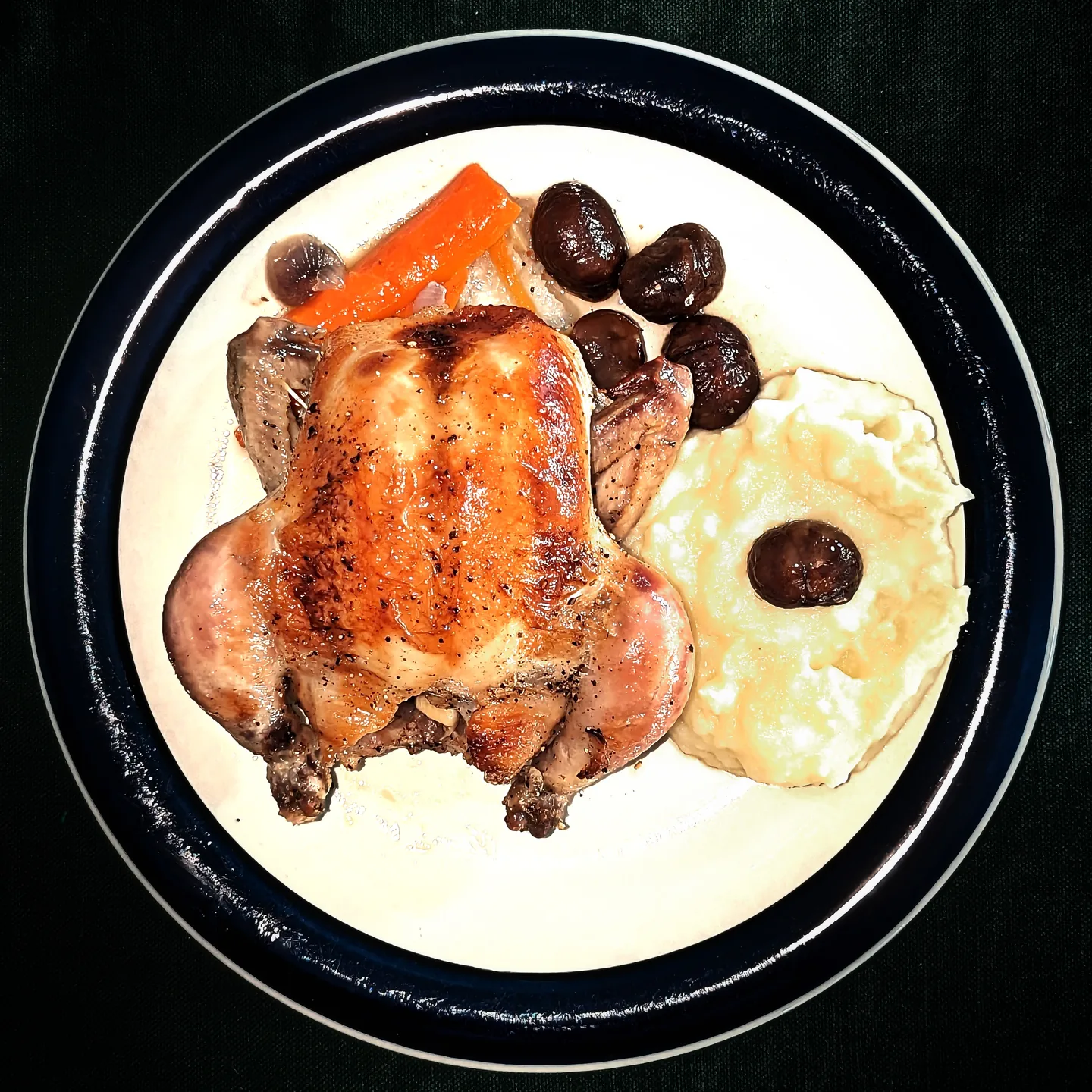
The USDA gives 350°F and 1¼ to 1½ hours for a 3- to 4-pound whole chicken, 2 to 2¼ hours at 5 to 7 pounds, and 165°F in the thigh, wing, and breast as the finish line.
A whole bird is one of the most forgiving things you can put in an oven, but two decisions set the result: how hot the oven runs and where you put the thermometer. Everything else, including whether the skin actually crisps, comes down to how dry it is when it goes in.
Key Takeaways
- The USDA times for unstuffed whole chicken at 350°F are 1¼ to 1½ hours for a 3- to 4-pound broiler-fryer and 2 to 2¼ hours for a 5- to 7-pound roasting hen.
- Doneness is 165°F, checked in the innermost thigh, the innermost wing, and the thickest part of the breast. Color and clear juices are not a test.
- Skin crisps when its surface is dry. Salt the bird and leave it uncovered in the refrigerator, then roast it without wet basting.
By Ashley. Safety guidance cited here comes from the USDA.
01 of 07 — Choose a Bird That Fits Your Schedule
The USDA’s chicken chart separates whole birds into two useful sizes, and the difference is more than portion count. A 3- to 4-pound broiler-fryer roasts in about an hour and a quarter. A 5- to 7-pound roasting hen needs roughly twice that. Buying the larger bird without moving dinner later is the most common way a roast chicken ends up carved late. The same weight-based logic drives how long to cook a turkey, just at a bigger scale.
Frozen chicken can go straight into the oven, according to USDA FSIS, but the cooking time may be about 50 percent longer. A fully thawed bird is easier to season under the skin and browns more evenly. If yours is still solid, the cold-water method in this guide to thawing a turkey safely works the same way for chicken: keep it sealed, change the water every 30 minutes, and cook it immediately afterward.
02 of 07 — Dry the Skin Before It Goes Into the Oven
Browning starts only after the surface water has evaporated. Serious Eats’ guide to dry brining, written by J. Kenji López-Alt, puts it plainly: dry surfaces brown, wet ones do not. A wet brine, the saltwater bath described in this guide to brining a turkey, leaves the skin saturated, which is why a brined bird can roast up pale and soft even when the meat underneath is juicy.
The fix is a dry brine. Rub salt over the whole bird, set it on a wire rack inside a rimmed sheet pan, and refrigerate it uncovered. The air in the fridge dries the surface while the salt seasons the meat. Serious Eats’ dry-brine guide suggests at least 12 hours and up to 3 days for a whole chicken, while USDA FSIS caps a refrigerated dry brine at 2 days; stay inside that window if you want to follow the federal guidance. Serious Eats’ roast chicken recipe allows as little as 1 hour if you are short on time. USDA FSIS lists a dry-brine ratio of 1 tablespoon of kosher salt per 5 pounds of poultry, which works out to about 0.6 teaspoon per pound. Serious Eats uses roughly 1 teaspoon of Diamond Crystal kosher salt per pound, about 1.7 times as much. Both sit in a normal range for a dry brine, so pick one and do not stack them.
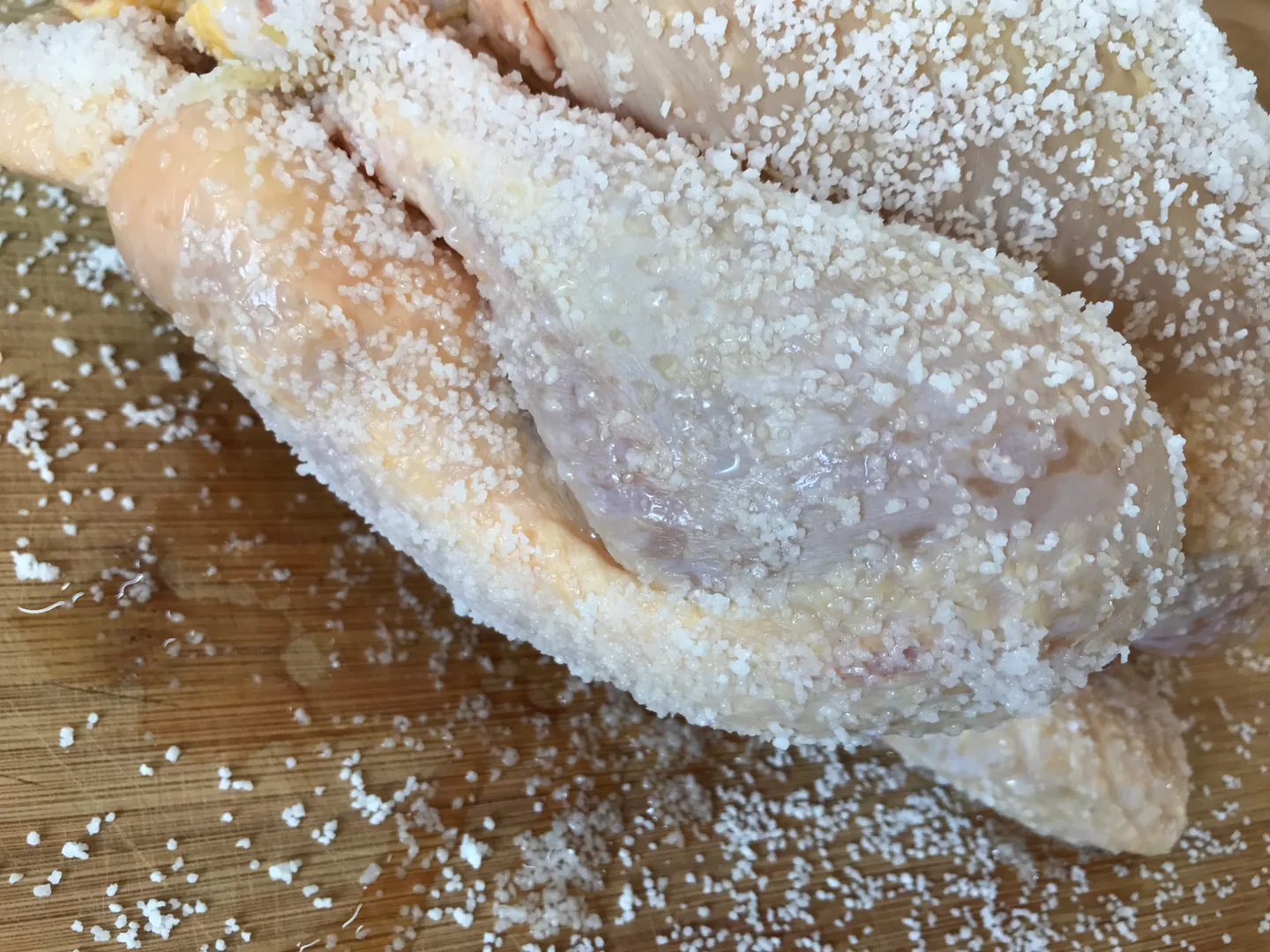
Two details protect the work you just did. Do not rinse the bird before roasting, because the water undoes the drying and USDA advises against washing raw poultry in general. And if you want extra crunch, Serious Eats mixes 1 part baking powder with 3 to 4 parts kosher salt before seasoning; the alkaline powder helps the skin brown and bubble. It is optional, and baking soda is not a substitute.
03 of 07 — Season, Rack, and Set the Oven
Salt the cavity as well as the skin, then rub the outside with a neutral oil or melted fat. Serious Eats notes that fat helps the skin brown evenly because it conducts heat well, while water-based basting does the opposite: every ladle of pan juices adds moisture back to the surface and slows browning.
Set the bird breast side up on a rack in a shallow roasting pan. The rack lets heat circulate underneath, so the underside is not sitting in drippings. USDA’s roasting directions call for exactly this setup, and the agency also sets a floor on oven temperature: do not roast below 325°F, because the bird spends too long in the range where bacteria multiply fastest. A 350°F oven sits comfortably above that line.
Stuffing is the one place to be strict. USDA does not recommend stuffing a whole bird, for food safety: the stuffing has to reach 165°F too, and in a large bird the meat around it can be done while the center is not. If you stuff anyway, expect an extra 15 to 30 minutes in the oven and check the stuffing as well as the meat. A separate dish of stuffing is simpler and removes the guesswork.
04 of 07 — Roast by Weight, Not by Guess
These are the USDA FSIS times for unstuffed whole chicken at 350°F (177°C). They are planning figures, not a substitute for a thermometer, and the agency describes them as approximate.
| Whole chicken | Oven temperature | Roasting time (unstuffed) |
|---|---|---|
| 3 to 4 lb broiler-fryer | 350°F (177°C) | 1¼ to 1½ hours |
| 5 to 7 lb roasting hen | 350°F (177°C) | 2 to 2¼ hours |
| Stuffed, any size | 350°F (177°C) | Add 15 to 30 minutes; stuffing must reach 165°F |
Start checking about 15 minutes before the low end of the range, and leave the oven door closed the rest of the time. Every opening drops the temperature and stretches the cook. If the skin is browning faster than the meat is cooking, tent a piece of foil loosely over the breast rather than lowering the oven below 325°F.
For even heat underneath: a shallow roasting pan with a rack

- MADE FOR FAMILY ROASTS — The 16 in. stainless steel roasting pan and removable rack handle holiday birds, large roasts and...
- EVEN HEAT AND MIRROR FINISH — Mirror-finish stainless steel roasting pan cooking surface does not react with food or alter...
- UNCOATED STAINLESS STEEL — Uncoated stainless steel delivers lasting durability and performance. This stainless steel roasting...

05 of 07 — Check Three Spots With a Thermometer
USDA FSIS is specific about where to check: the innermost part of the thigh, the innermost part of the wing, and the thickest part of the breast. All three need to read 165°F. Keep the probe away from bone, fat, and gristle, which heat differently from meat and give a false reading.
There is no shortcut here. USDA’s guidance is that you cannot tell whether poultry is done by looking at the color of the meat or the clarity of the juices, because bacteria that cause illness are not visible. A bird can look perfect and still be under temperature at the joint.
For a true 165°F read: a digital instant-read thermometer

- 【8X Faster + 4X More Precise】: Upgraded with an industrial-leading professional thermocouple sensor, Themomonster meat...
- 【Temperature Lock & Long Probe】: With a 4 inch long probe and the temperature lock, you can easily measure and read the...
- 【Auto Flip Large LCD Display】: Features an innovative auto flip large LCD screen with exceptional brightness, this food...
06 of 07 — Rest It, Then Carve
USDA’s safe temperature chart lists a three-minute rest for beef, pork, veal, and lamb, and no rest time at all for poultry: once the bird hits 165°F, it is safe. Resting is still worth doing for the plate. Serious Eats’ spatchcocked roast chicken rests five minutes before carving, which gives the juices time to settle and makes the joints easier to find.
To carve, take off the legs and wings first, then slice the breast across the grain. The joint-by-joint method in this guide to carving a turkey applies to chicken at a smaller scale. While the bird rests, set the pan over medium heat, add a splash of stock or wine, and scrape up the browned bits; the same technique behind turkey gravy from pan drippings makes a two-minute sauce from a chicken pan.
07 of 07 — Store and Reheat What Is Left
USDA FSIS says cooked food goes into the refrigerator within 2 hours, or within 1 hour if the room is above 90°F. Carve the meat off the carcass, pack it in shallow containers so it cools quickly, and keep it no more than 3 to 4 days. Reheat leftovers to 165°F.
| Item | Guidance | Source |
|---|---|---|
| Refrigerator time before packing leftovers | Within 2 hours (1 hour above 90°F) | USDA FSIS |
| Cooked chicken in the refrigerator | 3 to 4 days | USDA FSIS |
| Cooked chicken in the freezer | 3 to 4 months | USDA FSIS |
| Reheating leftovers | 165°F | USDA FSIS |
A cold chicken also gives you a head start on the rest of the week. Pulled meat goes into these 10-minute Buffalo chicken salads or a pot of chicken and beef taco soup. If you would rather start from raw chicken next time, the same oven logic runs through creamy garlic marry me chicken and these chicken and broccoli bowls. For more ideas, browse the rest of the Food category.
Roast Whole Chicken FAQ
How long does a 4-pound chicken take to roast?
At 350°F, USDA FSIS gives 1¼ to 1½ hours for a 3- to 4-pound unstuffed whole chicken. Start checking with a thermometer about 15 minutes before the early end of that range, because oven calibration and bird shape both shift the timing.
Should I cover the chicken with foil while it roasts?
Not for the whole cook. Foil traps steam, and steam is what keeps skin soft. If the breast is browning well before the thigh reaches 165°F, tent foil loosely over just the breast for the last part of the roast, and keep the oven at 325°F or above.
Can I roast a chicken straight from frozen?
Yes. USDA FSIS says chicken can be cooked from the frozen state in the oven or on the stove, and the cooking time may be about 50 percent longer. It still has to reach 165°F in the thigh, wing, and breast. A thawed bird seasons and browns more evenly, so thaw first when you have the time.
Do I need to baste the chicken?
Basting with pan juices works against crisp skin. Serious Eats points out that those juices are mostly water, and wetting the skin slows browning. Oiling the skin before roasting gives you the shine and even color people are usually after, without opening the oven every 20 minutes.
How do I know the chicken is done without a thermometer?
You cannot know reliably. USDA says color and juice clarity are not safe indicators. An instant-read thermometer is inexpensive and takes a few seconds, and it is the only way to confirm 165°F at the thigh, wing, and breast.
How long do roast chicken leftovers keep?
Refrigerate them within 2 hours of cooking, keep them 3 to 4 days, and reheat to 165°F. Frozen leftovers keep about 3 to 4 months, according to USDA FSIS, though they lose moisture and flavor over time.
Sources
- USDA Food Safety and Inspection Service, Chicken from Farm to Table — roasting times at 350°F, stuffing guidance, frozen cooking, 165°F doneness.
- USDA FSIS, Poultry: Basting, Brining, and Marinating — dry-brine ratio of 1 tablespoon kosher salt per 5 pounds of poultry, and the 2-day refrigerator limit.
- FoodSafety.gov, Meat and Poultry Roasting Charts — whole chicken times and the 325°F minimum oven temperature.
- USDA FSIS, Safe Minimum Internal Temperature Chart — 165°F for all poultry; rest times.
- USDA FSIS, Leftovers and Food Safety — 2-hour rule, 3 to 4 days refrigerated, 3 to 4 months frozen, reheat to 165°F.
- Serious Eats, Dry Brine Is the Best Way to Brine Meat, Poultry, and More, by J. Kenji López-Alt — dry skin and browning, salting times, optional baking powder.
- Serious Eats, Perfect Roast Chicken Recipe — oiling the skin and avoiding wet basting.
- Serious Eats, Spatchcocked (Butterflied) Roast Chicken — five-minute rest before carving.