
The turkey is out of the oven, everyone is hungry, and the bird is still too hot — and too whole — to slice neatly. A short rest, a sharp knife, and a few cuts at the joints will get you from a whole roast to a platter of slices without hacking through bone.
The short answer: the USDA Food Safety and Inspection Service (FSIS) says to confirm the turkey has reached 165°F in the thickest part of the breast, the innermost part of the thigh, and the innermost part of the wing, then let it rest 20 minutes before carving so the juices set. Serve it right away, or keep cooked turkey hot above 140°F. The carving steps below follow Illinois Extension; they are not kitchen-tested here. If you still need to time the roast or thaw the bird safely, start there first.
Before You Carve: A Quick Checklist
| Step | What to do |
|---|---|
| Doneness | 165°F in the thickest breast, innermost thigh, and innermost wing (USDA FSIS) |
| Rest | 20 minutes, so the juices set (USDA FSIS) |
| If not serving yet | Keep cooked turkey hot above 140°F (USDA FSIS) |
| Leftovers | Refrigerate within 2 hours, or 1 hour if the air is over 90°F (USDA FSIS) |
Those temperatures and times come from USDA FSIS, including Is the Turkey Done Yet? (last updated November 24, 2025) and the leftovers guidance cited later in this article. A food thermometer is the only reliable way to know the turkey is done; color alone is not enough.
What You Need to Carve a Turkey
Illinois Extension lists a meat fork with long tines, a sharpened carving knife or chef’s knife, a small cutting board on the side, and a kitchen towel or napkin. The National Turkey Federation adds a large cutting board (one with a groove, or “moat,” to catch juices is helpful), a serving platter, and an extra board or platter for the pieces as you take them off the bird. A damp towel under the cutting board can keep it from sliding while you work.
For the knife, the National Turkey Federation recommends a carving knife or a chef’s knife at least 8 inches long, and preferably 10 inches, and one that is not too thin or too thick. They do not recommend a serrated knife or an electric carving knife, which they say tends to shred the meat instead of slicing it cleanly. Sharpen the knife before you start. Illinois Extension also notes that you can practice the same joint cuts on a chicken when it is not a holiday bird.

- PREMIUM PERFORMANCE: Elevate your carving game with this premium carving set, featuring an ultra sharp 9" carving knife and a...
- RAZOR-SHARP BLADE EDGE: Our carving knife's blade edge reduces friction, ensuring clean, effortless cuts every time. Make your...
- PERFECT GIFT: Impress the chef in your life with this carving knife set for meat, an ideal gift for any occasion. The exquisite...

- 【MADE OF BAMBOO】Empune cutting boards are made of bamboo which can give you long-lasting service. Not only can they last for a...
- 【BUILT-IN JUICE GROOVE】Equipped with a juice groove around the edge to catch any excess juices or liquids during food prep. No...
- 【BUILT-IN SIDE HANDLES】Our conveniently built-in side handles allow easy carrying which doubles the chopping board as a...

How Long to Rest a Turkey Before Carving
Use the USDA FSIS 20-minute rest as the safety and carving baseline. After you have confirmed 165°F in the breast, innermost thigh, and innermost wing, FSIS says to “let the turkey rest for 20 minutes before carving to help juices set,” then “serve immediately or keep cooked turkey hot above 140 degrees F until ready to serve.” Turkey Basics: Safe Cooking adds, for quality, “let the bird stand 20 minutes before removing the stuffing and carving the bird to allow juices to set. The turkey will carve more easily.” Illinois Extension also uses a 20-minute rest so the juices can settle for better slicing.
Timing note: The National Turkey Federation separately recommends a longer rest for juiciness: “at least a 1/2 hour and up to 1 hour” after the turkey comes out of the oven, on the rack in the pan or on a board with a moat, and they advise against tenting with foil because it can make the skin soggy. That is quality advice from that source, not a USDA rest time — do not blend it with the FSIS 20-minute figure into one number. If you follow a longer rest, cooked turkey still must not sit out past the 2-hour rule in FSIS leftovers guidance (1 hour if the air is over 90°F). Keep it hot above 140°F, or carve and refrigerate promptly.
Safety note: If the bird was stuffed, USDA FSIS says the turkey and the center of the stuffing must both reach 165°F, and “for optimum safety, cook stuffing in a casserole.” After the rest, remove the stuffing before or as you carve. Use a thermometer; do not guess a stuffing-in-the-bird time.
How to Carve a Turkey, Step by Step
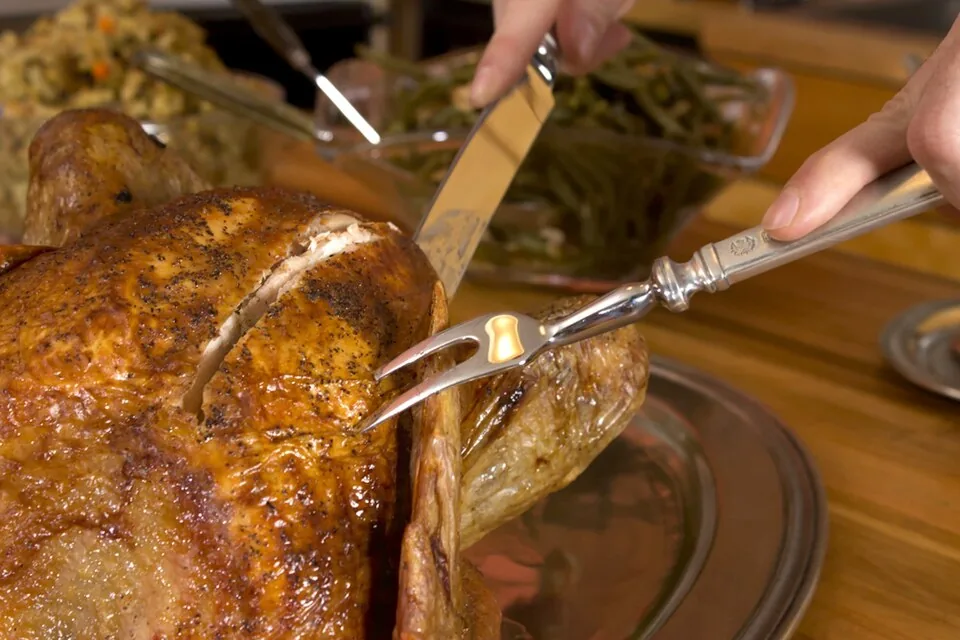
Illinois Extension’s main rule is simple: “you must cut the bird apart at the joint, hacking though the bone is not an option.” They start with the dark meat. The National Turkey Federation uses the same joint cuts and removes the wings before the breasts. Either order works once the legs are off. The sequence below is legs, then wings, then breasts, using Illinois Extension’s joint-cutting method. These are extension steps, not a timing test from this kitchen. The National Turkey Federation also suggests tipping the turkey in the pan first so juices go back into the drippings (useful for turkey gravy) and removing any trussing or aromatics from the cavity.
- Set the turkey up. Place it breast-side up. Illinois Extension says to secure it at the breastbone with a carving fork, or with a folded napkin. Have a side board and a platter ready.
- Remove the legs and thighs at the hip joint. Cut through the skin between the leg and the body. Press the leg downward until it lies flat so you can see the hip joint. Cut through that joint and move the leg and thigh to the cutting board. Repeat on the other side.
- Separate the thigh and the drumstick. Cut them apart at the joint. Illinois Extension says to remove the skin and slice around both sides of the thighbone to take off the meat, and to leave the drumstick whole for now. Repeat with the other leg.
- Remove the wings at the joint. If the wing tips are tucked, untuck them. Cut into the joint slightly above the wing, pull the wing outward, and cut through the joint. Illinois Extension says you can cut the wing in two at the joint, slice the meaty part or serve it whole, and save the tip for soup. Repeat on the other side.
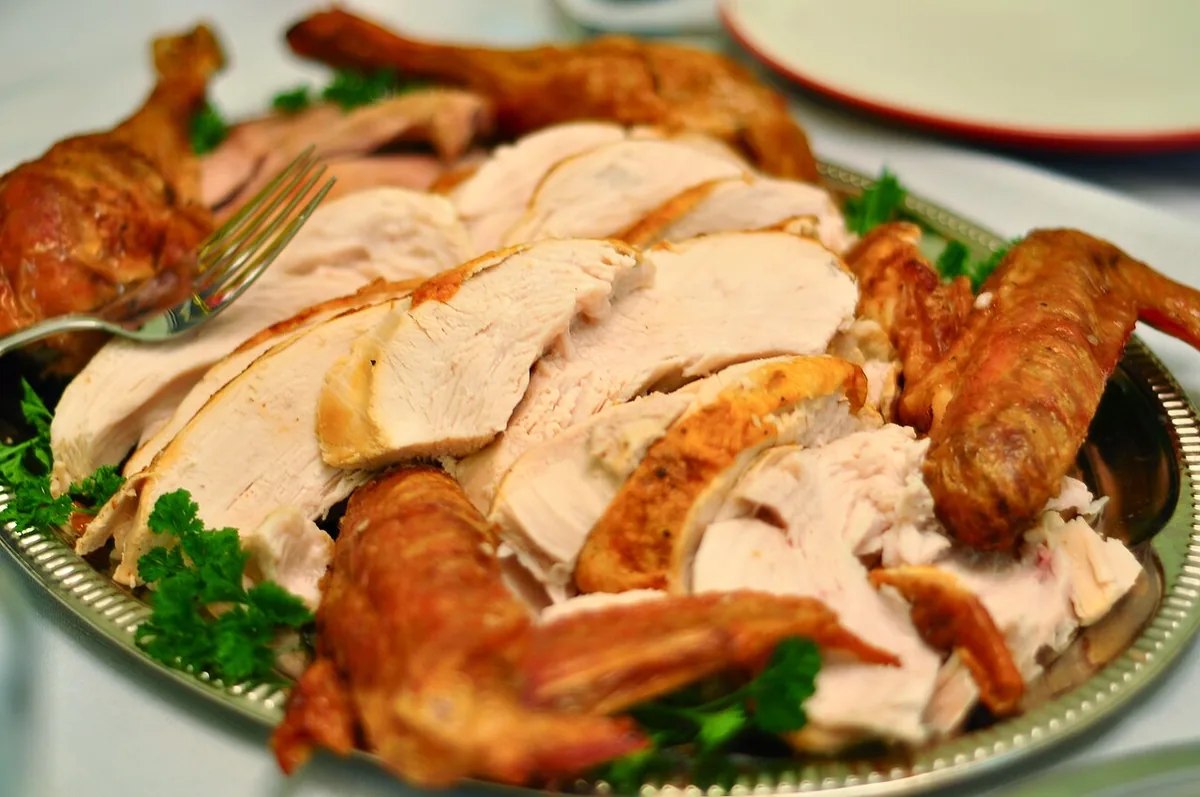
- Take each breast off the bone, then slice across the grain. Hold the turkey at the breastbone with a fork. Illinois Extension’s method is to slice about 2 inches down one side of the breastbone, gently separating the meat from the bone, then make a horizontal slice across the grain and lift the whole section onto the cutting board. Slice it and arrange the pieces on the platter. Repeat on the other side. The National Turkey Federation describes a similar path: a deep horizontal cut just above the thigh and wing joints, then a downward slice along the breastbone and ribs so that side comes off in one piece. They suggest slices about 1/4 to 1/3 inch thick, kept stacked so you can move them neatly.
- Slice the drumsticks if you want to. Illinois Extension says to cut slices parallel to the bone, then turn and repeat. You can also serve the drumsticks whole.
Arrange the slices, thighs, drumsticks, and wings on a clean platter. Illinois Extension’s Turkey Safety Hotline, which is the USDA Meat and Poultry Hotline, is 1-888-MPHotline (1-888-674-6854) if you have a safety question while you work.
How to Carve a Turkey Breast
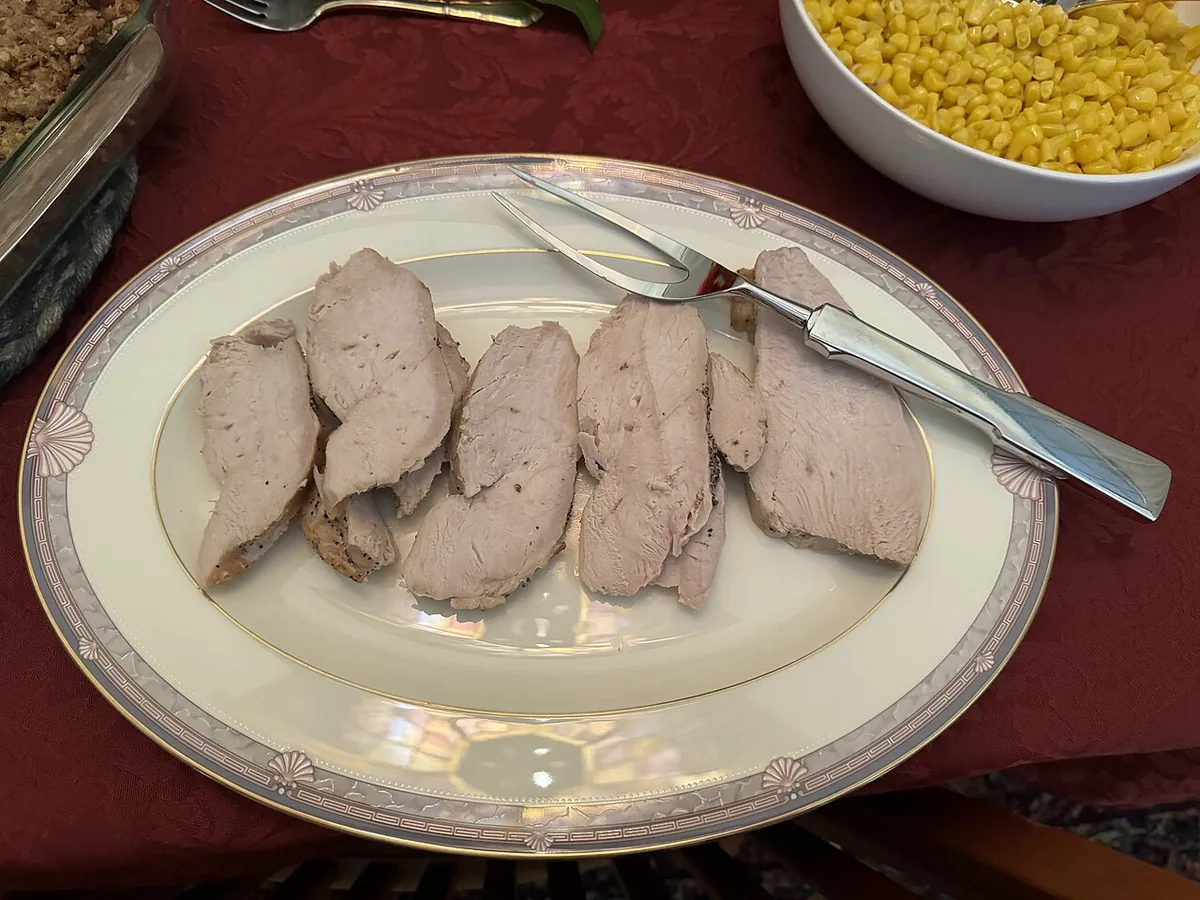
If you roasted a turkey breast instead of a whole bird, the doneness and rest rules are the same. USDA FSIS still calls for a 165°F minimum internal temperature, checked in the thickest part of the breast, and a 20-minute stand before carving so the juices set. For a bone-in breast, use the same Illinois Extension idea: work along the breastbone to free the meat in one piece, move it to the cutting board, and slice it across the grain. For a boneless roast, skip the bone and slice across the grain on the board.
After You Carve: The Carcass and Leftovers
Set the carcass aside. It can go into a pot of leftover broth later; this article does not include a stock recipe. For cooked leftover meat, see our leftover turkey recipes.
USDA FSIS leftovers guidance (last updated July 31, 2020) says bacteria grow rapidly between 40°F and 140°F. “Within 2 hours of cooking food or after it is removed from an appliance keeping it warm, leftovers must be refrigerated. Throw away all perishable foods that have been left in room temperature for more than 2 hours (1 hour if the temperature is over 90°F…).” Cool food rapidly in shallow containers. For turkey, FSIS says: “Cut turkey into smaller pieces and refrigerate. Slice breast meat; legs and wings may be left whole.”
Storage note: The times below are the full refrigerator and freezer rows from FSIS, Turkey Basics: Handling Cooked Dinners (last updated September 25, 2024). On the general leftovers page, FSIS also says leftovers keep 3 to 4 days in the refrigerator or 3 to 4 months in the freezer, and that frozen leftovers remain safe indefinitely as quality declines. The FoodSafety.gov cold-food storage chart (reviewed September 19, 2023) lists leftover cooked meat or poultry as 3 to 4 days refrigerated and 2 to 6 months frozen. Use the turkey-specific FSIS table for leftover turkey; do not blend the freezer ranges into one number.
| Leftover | How long |
|---|---|
| Cooked turkey (fridge, 40°F or below) | 3 to 4 days |
| Cooked dishes and gravy (fridge) | 3 to 4 days |
| Turkey, plain slices or pieces (freezer, quality) | 4 months |
| Turkey covered with broth or gravy (freezer, quality) | 6 months |
| Cooked poultry dishes, stuffing, and gravy (freezer, quality) | 4 to 6 months |
FSIS notes that freezer storage times are for quality only; frozen foods remain safe indefinitely. When you reheat leftovers, FSIS says they should reach 165°F as measured with a food thermometer, and to “reheat sauces, soups and gravies by bringing them to a rolling boil.” The cooked-dinners page also says to reheat thoroughly to 165°F or until hot and steaming, and to bring gravy to a rolling boil. Reheating a whole leftover turkey is not recommended; cut it into smaller pieces first.
Turkey Carving FAQ
How long should a turkey rest before carving?
USDA FSIS says 20 minutes after the turkey has reached 165°F in the breast, innermost thigh, and innermost wing, so the juices set. The National Turkey Federation separately suggests 30 to 60 minutes for juiciness. If you use that longer rest, do not leave cooked turkey out past the 2-hour rule (1 hour if it is over 90°F).
Where do I check the temperature before I carve?
USDA FSIS says to use a food thermometer in three places and to avoid bone, fat, or gristle: the thickest part of the breast, the innermost part of the thigh, and the innermost part of the wing. All three should read 165°F.
Should I use an electric knife?
The National Turkey Federation does not recommend a serrated knife or an electric carving knife, because they say it tends to shred the meat instead of slicing it cleanly. A sharp 8- to 10-inch carving knife or chef’s knife is their recommended tool.
What if the turkey was stuffed?
USDA FSIS prefers stuffing cooked in a casserole. If you stuffed the bird, the center of the stuffing must also reach 165°F. After the 20-minute rest, remove the stuffing before or as you carve.
How long does leftover carved turkey keep?
According to the FSIS cooked-dinners storage table, cooked turkey keeps 3 to 4 days in the refrigerator at 40°F or below. Refrigerate it within 2 hours (1 hour if the air is over 90°F) in shallow containers. Reheat leftovers to 165°F, and bring gravy to a rolling boil.
A Steady Platter, Then the Sides
Once the slices are on the platter, the hard part is over. If you still need a plan for the pan juices or the leftover meat, see how to make turkey gravy and easy leftover turkey recipes. For the roast itself, how to brine a turkey, how to thaw a turkey, and how long to cook a turkey are the earlier steps in the same sequence.