
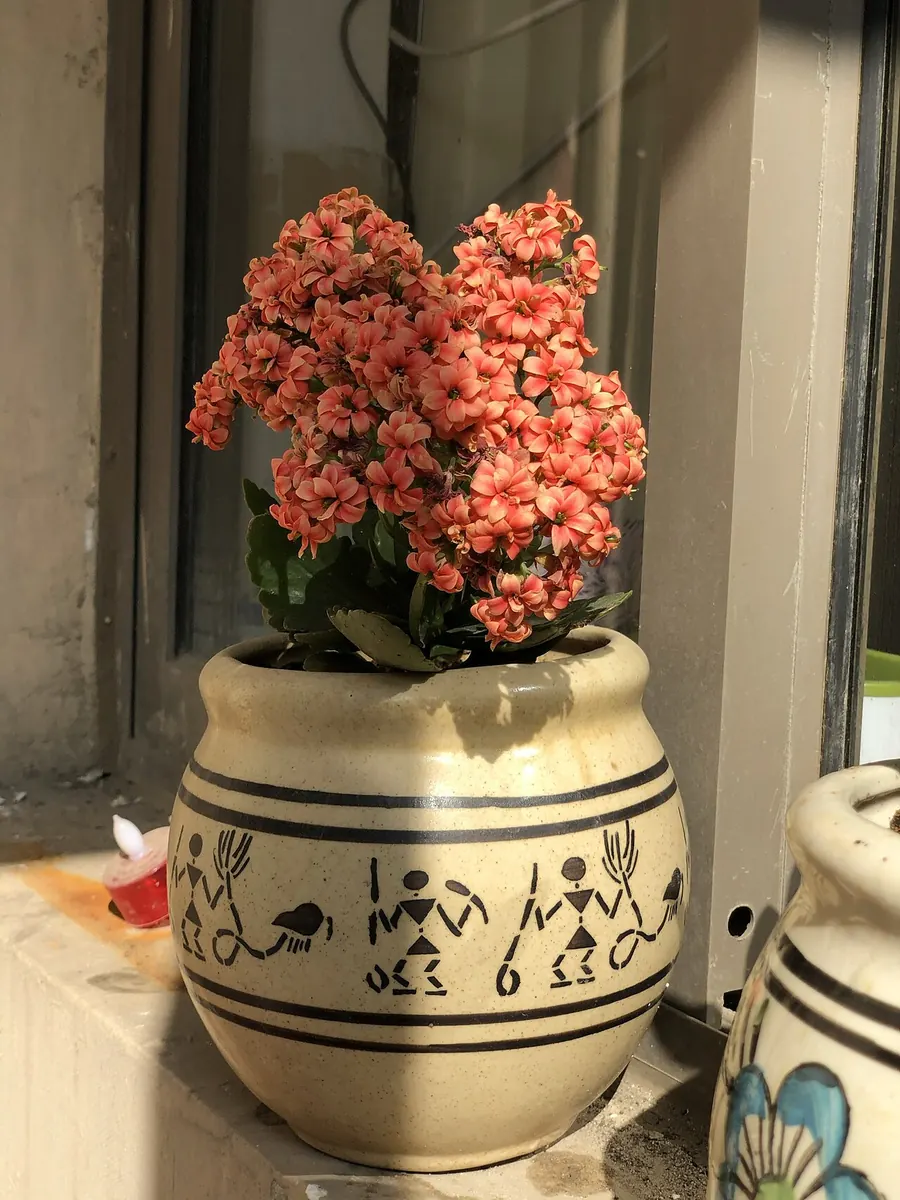
The compact pot plant sold from Thanksgiving through winter is a florist kalanchoe, also called Flaming Katy or Christmas kalanchoe — usually Kalanchoe blossfeldiana or a hybrid of it, not a hardy garden succulent.
The short answer: unwrap foil or open the sleeve so water can drain, set the plant in a bright indoor spot, and water only after the mix has dried, never leaving the pot in standing water. After the flowers fade, compost the plant or try a short-day treatment to bloom again. Care below comes from university extension services and the Royal Horticultural Society, not windowsill tests.
Kalanchoe Care at a Glance
| Need | Start here |
|---|---|
| Light | A bright indoor spot; low light makes plants spindly. See the sourced ranges below. |
| Water | Let the mix dry, then water. Empty sleeves and saucers so the pot never sits in water. |
| Temperature | Sources give slightly different indoor ranges; cooler nights help flowers last. |
| After bloom | Deadhead spent flowers. You may compost the plant or try a sourced short-day method. |
| Pets | The ASPCA lists Kalanchoe as toxic to dogs and cats. |
Those points are a starting map, not a single homemade schedule. The sections below keep each institution’s numbers and methods distinct.
What Is a Florist Kalanchoe?
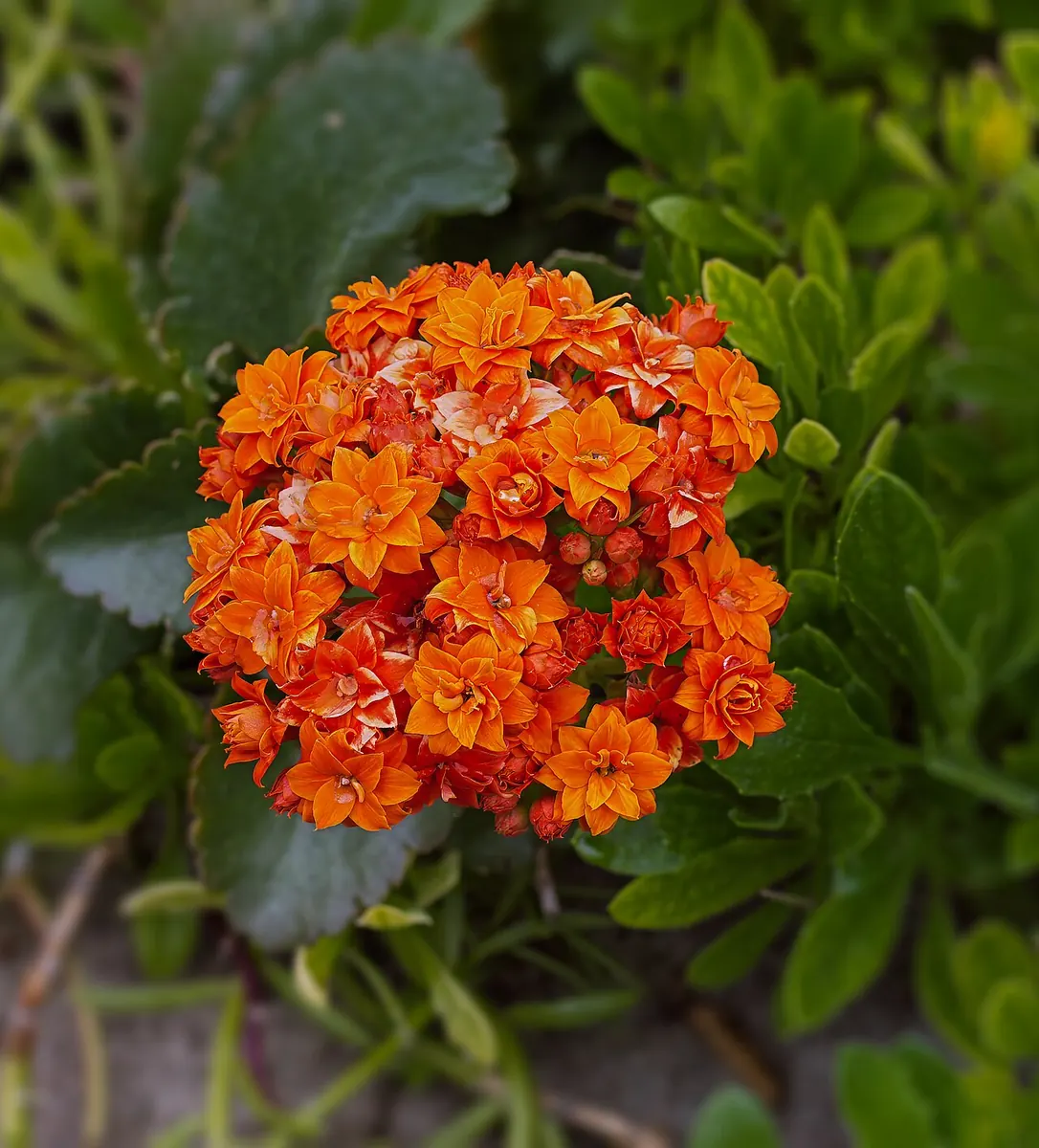
University and botanical sources describe florist kalanchoe as a compact flowering succulent in the stonecrop family (Crassulaceae), native to Madagascar or, more specifically, Northeast Madagascar. North Carolina State Extension lists the common names Christmas kalanchoe, florist kalanchoe, and Madagascar widow’s-thrill, and identifies the plant as Kalanchoe blossfeldiana. Illinois Extension also uses Christmas kalanchoe. The Royal Horticultural Society uses the common name Flaming Katy. Grocery-store plants are often hybrids of this species; the article treats them as the florist plant you just bought, not as a field guide to every kalanchoe.
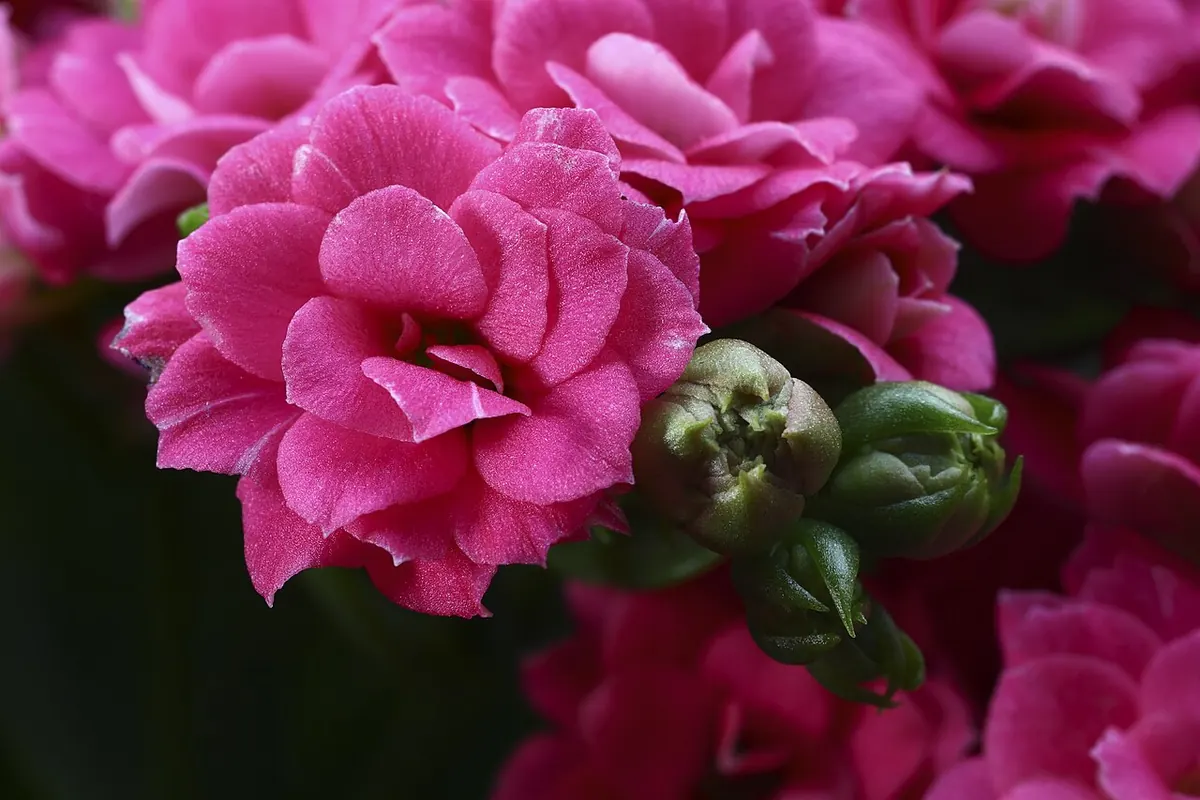
The look is consistent even when sizes differ by source. Leaves are thick, fleshy, and usually dark green with scalloped edges. Tiny flowers are held in clusters above the foliage. Clemson and Illinois describe typical flowers as four-petaled; both, with NC State, also note double-flowered cultivars. Clemson says a double bloom may have as many as 26 petals. Colors commonly listed include red, orange, yellow, pink, and white; Illinois also lists salmon and purple, and Clemson lists magenta.
Mature size should be read as each source states it, not as one blended range. NC State describes a compact plant 6 to 18 inches tall and 6 to 12 inches wide. The RHS profile gives a bushy evergreen succulent to 40 cm, with a maximum height and spread of 0.1 to 0.5 metres. Illinois says plants can grow up to 2 feet in height and width.
Growing note: Clemson Extension notes that kalanchoe is typically available in late winter and spring. That does not conflict with buying one as a holiday plant now; it only means the same florist crop is also sold later in the season.
Other kalanchoe species you may have searched for are not this grocery-store pot plant and do not share the same holiday care. NC State’s panda plant page describes Kalanchoe tomentosa as a fuzzy-leafed succulent grown for foliage, hardy outdoors in USDA Zones 9 to 11, and reaching 1 to 3 feet tall; it also says indoor plants rarely flower. The RHS sunny-rooms guide likewise treats panda plant as K. tomentosa, separate from Flaming Katy. NC State’s mother-of-thousands page describes Kalanchoe daigremontiana as a plant that forms plantlets along the leaf edges and can grow up to 3 feet tall, hardy in Zones 9 to 11. University of Missouri Extension makes the same contrast: florist’s kalanchoe is the colorful pot plant, while mother-of-thousands reproduces from those leaf-edge plantlets. Those species need their own care.
When You Bring a Holiday Kalanchoe Home
Florist pots are often dropped into decorative foil, a plastic sleeve, or a cachepot with no drainage. Iowa State University Extension says good drainage is essential and you should never allow containers to sit in sleeves full of water. Missouri Extension says that if the pot has a saucer, drain any excess water so it is not wicked back into the mix. Unwrap the foil or open the sleeve, confirm that water can leave the pot, and set the grower’s pot into a decorative container only if you can still empty water that collects underneath.

- Plant Pots / Flower Pots - Invest in a beautiful garden to harvest the seeds of love, with the set of pots for indoor or outdoor...
- Multiple Sizes – This nursery plant pots indoor comprises multi-size pots – Extra Large (7” W x 5.9” H), Large (6.6” W x...
- Impeccable Febrication - Make the pots ideal for both original and fake plants comprises of reinforced PP plastic. The hassle-free...
Place the plant in a bright indoor location as soon as you get it home. Clemson and Missouri both warn that plants tend to get spindly in low light. NC State recommends 6 to 8 hours of bright light a day if you want the plant to keep blooming, and says prolonged direct sun can scorch the leaves, so afternoon shade is recommended. The RHS profile places the plant in bright filtered light and lists its position as partial shade. Those are the sources’ own wordings; they are not a foot-candle target or a set number of hours invented for this article.
Care tip: You do not need to repot a plant that is in full flower the day you bring it home. Clemson’s repotting note comes after flowering, when the plant is shifted to a slightly larger pot, not as a mandatory unpacking step.
Light and Temperature for Kalanchoe Care Indoors
Florist kalanchoe is a succulent and wants more light than a typical low-light houseplant, but the sources do not all describe that light in the same way. NC State prefers bright indirect sunlight or partial shade and warns that prolonged direct sun can scorch leaves. Illinois also prefers bright indirect sunlight. Missouri simply says the plant enjoys bright light. Clemson says it grows best in full sun and a well-drained mix, and that it will also tolerate bright indoor light. The RHS advises bright filtered light indoors. Use those descriptions as written; do not average them into a single invented exposure.
Indoor temperature guidance also differs, and cooler conditions are consistently tied to longer flower life rather than to a personal test:
- NC State prefers 60°F at night and 70°F during the day, and says to bring the plant indoors before temperatures drop to 45°F in cooler climates.
- Missouri prefers about 60°F at night and about 70°F during the day, and says temperatures over 75°F tend to delay or reduce flowering.
- Illinois gives the same 60°F night and 70°F day range, and says temperatures outside that range may negatively impact flower development.
- Iowa State gives a wider moderate range of 45–65°F at night and 50–70°F during the day, and says keeping plants on the cool side will help prolong flower life.
- Clemson uses the same 45–65°F night and 50–70°F day range as Iowa State, and also says cool night temperatures prolong flower life. During the long-night period used for rebloom, Clemson warns that temperatures above 80°F can cause a “heat delay” that inhibits flower development.
The RHS does not publish a household °F range on its profile. It rates the species H1B on the UK scale, meaning it can be grown outside in the summer at 10–15°C, and otherwise treats it as an indoor or conservatory plant.
How to Water a Florist Kalanchoe
Overwatering is the usual way these plants fail. They are succulents with fleshy leaves, and the extensions agree that the mix should dry before you water again. None of them gives a calendar schedule such as “once a week,” so this article does not invent one.
- NC State: allow the soil to dry out between waterings, then water deeply. Overwatering can cause root rot or stem rot.
- Iowa State: allow the soil to dry between waterings, but not to the point of wilt, and never leave the pot in a sleeve full of water.
- Missouri: allow the growing medium to dry before watering, and empty the saucer. Overwatering can cause crown rot and sudden plant death.
- Clemson: allow the soil to dry slightly between waterings. Root rot usually comes from a mix that does not drain quickly or from watering too often. Do not let plants sit in water.
- Illinois: use a very well-drained mix; overwatering can lead to stem or root rot.
- RHS: water moderately when the plant is in growth and sparingly when it is dormant.
If the pot is inside a cover that cannot drain, take it out to water, let it finish dripping, then put it back. A wet sleeve is not a watering method.
What to Do After a Kalanchoe Finishes Blooming
Once the clusters fade, start by removing spent flowers. NC State recommends deadheading to encourage more blooms. Clemson says to cut back tall growth and old flower stems, and then, if you are keeping the plant, shift it to a slightly larger pot in a well-drained, well-aerated mix (Clemson suggests 60% peat moss and 40% perlite).
How long the first display lasts is not a single number. Illinois says flowers can last six weeks or more when the plant is cared for well. NC State says blooms can last for several weeks. The RHS sunny-rooms guide says Flaming Katy flowers can last for many months. Cooler rooms, as Iowa State and Clemson note, help the flowers last; a hot, dim corner works against that.
Getting the same plant to bloom again is a short-day project, and the sources do not describe one identical timetable. Florist kalanchoe needs long nights to set flower buds, like a poinsettia. You should follow one sourced method rather than mixing them, and you should not treat yearly rebloom as a guaranteed result.
- Iowa State: the process is difficult for some home gardeners. In October, put the plant in a room where lights are not turned on at night, with only natural light during the day. Six weeks of 14-hour nights are required for flower buds to form, at 65–70°F by day and 60–65°F at night. Because reblooming can be difficult, plants can be discarded after bloom.
- Missouri: after frost danger has passed, move the plant outdoors in light shade or indirect sun, and cut it back to about half its height if it has become tall and leggy. For Christmas blooming, start short-day treatment around mid-September after the plant is back indoors. A 14-hour dark period with no light at all during those hours, then 10 hours of light, gives the most blooms. Feed and water sparingly during induction. Missouri says plants should bloom in about six weeks.
- Clemson: natural day lengths between October 1 and March 1 allow flower buds to form. Keep the plant in a room without night lighting, or use a closet in late afternoon and bring it into high light each morning. About six weeks of natural winter day lengths are needed for buds to form; those nights are 14 to 16 hours long. After buds are large enough to be seen above the foliage, day length is no longer crucial. Plants started on naturally short days in early October should begin flowering by January, about 12 weeks from the start of long nights. Temperatures above 80°F during the long-night period can delay flowering.
- NC State: in fall and winter, total darkness is required for 14 hours a day for at least six weeks. Blooms will appear in the spring. Failure to bloom may mean the plant did not get that dark period.
- Illinois: blooms are initiated after six weeks of nights at least 14 hours long.
Those “about six weeks,” “about 12 weeks,” and “blooms in the spring” statements belong to their own sources. This article does not average them into one promise. If you would rather not manage long nights, Iowa State’s option to discard the plant after bloom is a legitimate choice.
Indoor Winter Care
A holiday kalanchoe already in bloom needs the same basics through winter: a bright spot, a mix that can dry, and no standing water. The short-day instructions above are what the sources say about winter if you are trying to set new buds, not a reason to put a flowering plant in a dark closet while it is still displaying.
In cold climates, treat florist kalanchoe as an indoor plant once nights turn frosty. NC State says it is hardy outdoors only in USDA Zones 10 to 12, is intolerant of frost, and should be brought indoors before temperatures drop to 45°F. Clemson says to bring plants back indoors before the first frost, or three months before the bloom time you want. Illinois, writing for Illinois conditions, says to treat the plant as an annual outdoors or move it back into a container when temperatures drop. Missouri would move plants indoors before starting a mid-September short-day treatment for Christmas bloom.
The RHS profile is written for UK conditions and rates the species H1B, which means it can be grown outside only in summer at 10–15°C. That is not a recommendation to plant a florist kalanchoe in the ground for a typical U.S. winter.
Feeding, Potting Mix, and Repotting
For houseplants, NC State recommends a well-drained potting mix suited for cactus or succulents. The RHS uses a peat-free, loam-based potting compost with extra grit. Clemson’s rebloom mix is 60% peat moss and 40% perlite. Illinois also stresses a very well-drained soil and notes that thick, water-holding leaves can make a pot top-heavy, so a stable container matters.

- Miracle-Gro Indoor Potting Mix for Cactus and Succulent is enriched with Miracle-Gro Plant Food and enhances desert plant vitality...
- This specially formulated blend contains forest products, sphagnum peat moss, sand, and perlite to promote fast drainage for...
- This cactus potting mix is designed for indoor container plants such as cacti, citrus trees, and succulents

Some cactus and succulent potting mixes already include plant food. If the bag says it feeds the plant for a period of time, follow that label and don’t add more fertilizer until that period is over.
Fertilizer advice is for actively growing plants and is not a year-round weekly program:
- Clemson: fertilize actively growing plants with any houseplant fertilizer once a month.
- Missouri: fertilize according to the label when the plant is actively growing; every two to three weeks during summer if the plant is outdoors; feed sparingly during flower induction.
- Illinois: use a well-balanced fertilizer, or a bloom-enhancing fertilizer with more phosphorus, on actively growing plants; use little fertilizer on plants moved outdoors for summer.
- RHS: apply a balanced liquid fertiliser two or three times in the growing season.
Clemson’s guidance to shift the plant to a slightly larger pot comes after flowering, not as a rule that every grocery pot must be changed on a set date. If the grower’s pot already drains and the plant is still in bloom, leave it until that display is over.
A Brief Note on Propagation
If you want another plant, the extensions support cuttings; this is not a full propagation guide. NC State and Illinois say florist kalanchoe can be propagated from stem or leaf cuttings. Clemson prefers vegetative (not flowering) terminal cuttings two to three inches long, taken in spring or early summer, with no rooting hormone, and allowed to callus for several days in a 50% peat and 50% perlite mix. Missouri uses 2- to 3-inch stem-tip cuttings and says rooting should occur within two to three weeks. Illinois also uses a two- to three-inch stem cutting, with a two- to three-day callus, and says roots develop in a few weeks. The RHS, by contrast, lists propagation by seed or offsets in spring. Use one sourced method; do not combine them into a homemade recipe.
Common Problems
| Problem | What sources point to |
|---|---|
| Spindly growth | Low light (Clemson, Missouri). Move the plant to a brighter spot rather than adding more water. |
| Soft stems or sudden collapse | Overwatering and poor drainage, including crown, root, or stem rot (Missouri, NC State, Clemson, Illinois, Iowa). |
| Flowers fade quickly | Warm rooms shorten flower life; Iowa State and Clemson say cooler nights help flowers last. |
| No rebloom | The plant did not get a long-night period, or nights were interrupted by lamplight (NC State, Clemson, Iowa). Clemson also cites heat delay above 80°F; Missouri cites delay above 75°F. |
| Pests | Aphids, mealybugs, and mites appear across sources; Clemson also lists brown scale, Illinois lists scale, and the RHS lists mealybugs and vine weevil. |
Powdery mildew is possible. NC State recommends good air circulation. Clemson says leaves may look mottled, with yellow spotting or ring patterns, and that plants may be stunted and fail to flower. Missouri notes that powdery mildew is more often a greenhouse problem, because the relative humidity of an average home is usually too low.
Is Kalanchoe Toxic to Cats and Dogs?
Yes. The ASPCA’s Kalanchoe page lists the plant under the scientific name Kalanchoe spp. It states: Toxic to Dogs, Toxic to Cats. Toxic Principles: Bufodienolides. Clinical Signs: Vomiting, diarrhea, abnormal heart rhythm (rare). That page does not list horses, and this article does not infer a horses listing from a different species record. It also does not claim that any part of the plant is safe to nibble.
If you think a pet has eaten the plant, contact a veterinarian or the ASPCA Animal Poison Control Center. Keep the pot where pets and children cannot graze on leaves or flowers.
Can You Plant a Florist Kalanchoe Outside?
Not for winter in most of the United States. NC State lists outdoor hardiness only in USDA Zones 10 to 12 and says the plant should come indoors before temperatures drop to 45°F. In those warm zones, NC State says it may be used as a groundcover or in rock gardens, raised planters, or containers. Illinois, for Illinois summers, would move plants outdoors in full sun to part shade in light, sandy soils, then treat them as annuals or bring them back inside when temperatures drop. Missouri and Clemson also describe a frost-free summer outdoors in light shade, then a return indoors before frost. The RHS H1B rating is a UK summer-outdoor rating, not a U.S. winter-hardiness zone.
If you bought a florist kalanchoe in November, keep it as a houseplant unless you live in a climate that matches those sourced outdoor limits.
Kalanchoe Care FAQ
How often should I water a kalanchoe?
There is no sourced calendar interval. Check the mix and water after it has dried, then let the pot drain completely. A wet decorative sleeve is a common reason these plants rot.
How do I get a kalanchoe to bloom again?
Follow one of the short-day methods above. The shared requirement is a stretch of long, truly dark nights — generally described as about six weeks of 14-hour nights — but the sources disagree on when flowers then appear. Do not count on a repeat Christmas display unless you can actually provide that dark period.
Should I throw the plant away when it fades?
You can. Iowa State says plants can be discarded after bloom because reblooming is difficult for some home gardeners. Keeping the plant is optional and means accepting a rest, a brighter growing-on period, and a later short-day treatment if you want flowers again.
Is a kalanchoe the same as a panda plant?
No. Panda plant is Kalanchoe tomentosa, grown mainly for its fuzzy leaves. Florist kalanchoe, or Flaming Katy, is the compact flowering pot plant described here.
Other Holiday Houseplants
Florist kalanchoe sits alongside other winter gift plants that also need careful indoor care. See our guides to poinsettia care, amaryllis care, how to grow paperwhites, Norfolk Island pine care, and cyclamen care. For another winter-blooming houseplant, we also have Christmas cactus care.
A bright window and a pot that can dry out will do more for a holiday kalanchoe than frequent watering. Once the last flowers fade, you can compost the plant or give it a sourced short-day rest; either choice is in line with the extensions.