

The cyclamen sold from Thanksgiving through Valentine’s Day is a florist or Persian cyclamen, a hybrid of Cyclamen persicum, not a hardy garden plant.
The short answer: give it a cool, bright room away from heat vents. Water from below or at the pot edge when the surface feels dry, and keep the crown dry; do not leave the pot standing in water. After the leaves yellow, the plant usually rests for summer, and reblooming at home is possible but often difficult. The care below comes from university extension services and the Royal Horticultural Society, not from windowsill tests.
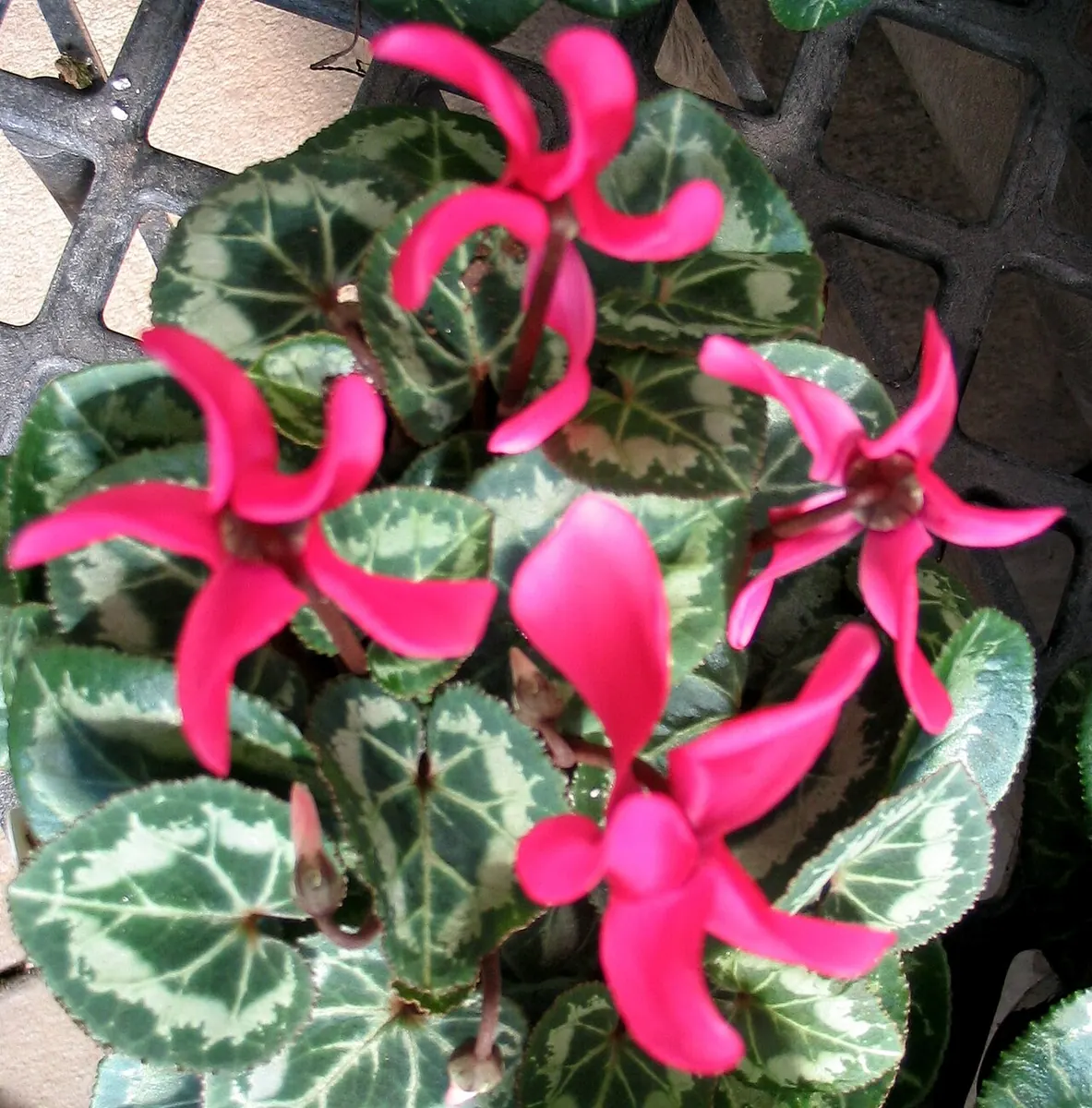
Cyclamen Care at a Glance
- Light
- Bright and indirect, or filtered. Keep off hot midday sun and heat sources.
- Temperature
- Cool room. Sources most often cite the 50s–mid 60s °F; heat above 70°F is a problem.
- Water
- When the surface feels dry. Water from below or at the pot edge. Keep the crown dry.
- Humidity
- Moderate to high while in bloom. A pebble tray can help if the pot is not in the water.
- Feeding
- A dilute or low-nitrogen fertilizer about every two weeks while it is growing.
- After bloom
- Leaves yellow and the plant rests. Rebloom is possible, but often hard in the home.
Those lines are a shorthand. The sections below note where sources differ and link to the original pages.
What Is a Florist Cyclamen?
The holiday plant is florist’s or Persian cyclamen. University of Wisconsin–Madison Extension describes today’s pot plants as hybrids of Cyclamen persicum. North Carolina State Extension also calls them Florist’s Cyclamen and notes that they are cultivars of the wild species, which is native from Algeria to the eastern Mediterranean, not actually from Persia even though persicum means “from Persia.” The Royal Horticultural Society lists the common name Persian cyclamen and treats the winter pot plant as a plant for the house, conservatory, or greenhouse.
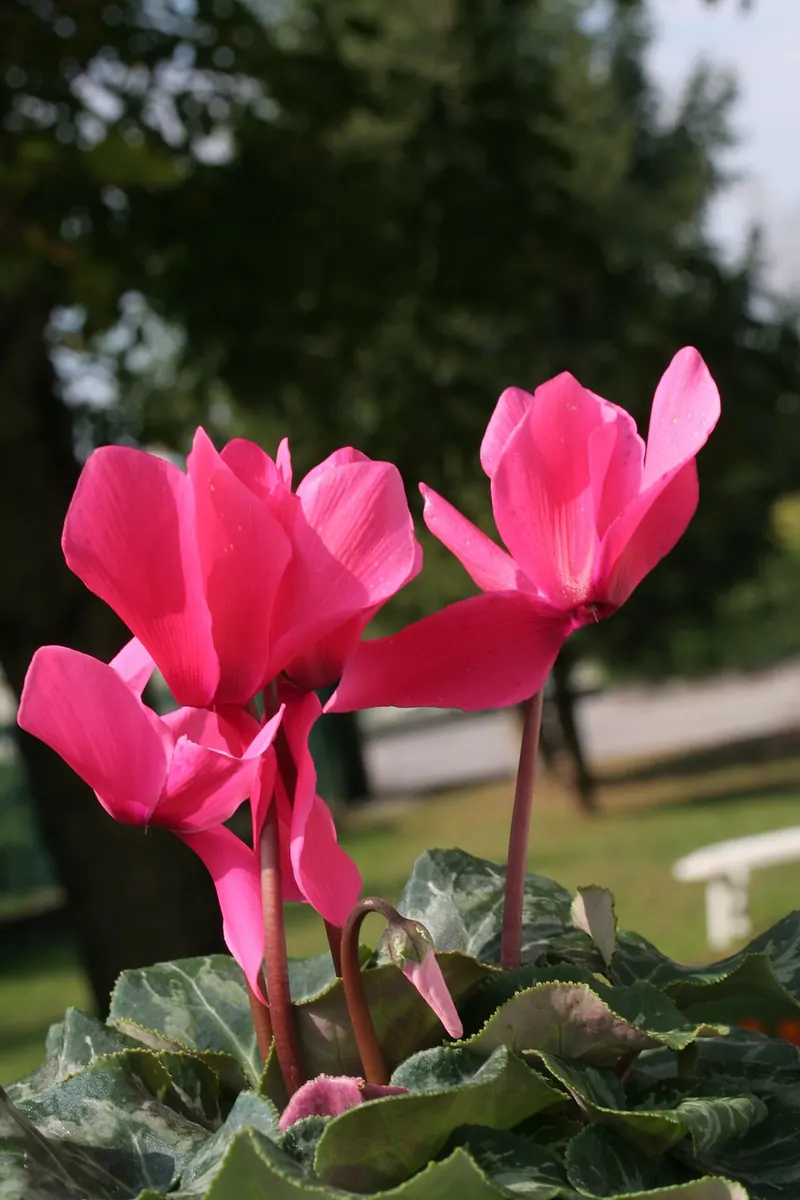
Expect a low mound of heart-shaped leaves, often marked with silver, and flowers on slender stems with petals that sweep backward. Height is not one number: Clemson Extension gives 6 to 16 inches, NC State gives 6 to 9 inches, Iowa State University Extension lists miniature plants 6 inches or less, intermediate sizes, and standard plants about 12 inches, and the RHS Christmas houseplant guide gives 15 cm (6 inches) to 30 cm (1 foot). Flower colors include white, pink, rose, red, purple, and lavender, and some types are frilled, doubled, or lightly scented.
It is not the same plant as hardy outdoor cyclamen such as Cyclamen hederifolium or Cyclamen coum. Those garden species are covered briefly at the end of this article. Florist cyclamen is frost tender. NC State lists winter hardiness only in USDA Zones 9–11 (its plant-toolbox table uses 9a–11b). Wisconsin says the species will not tolerate frost and is grown primarily as a houseplant. The RHS rates C. persicum H1C on the UK hardiness scale, meaning it can be grown outside in summer in the 5 to 10°C range, and still recommends growing it indoors or under glass.
When You Bring a Holiday Cyclamen Home
Iowa State University Extension and the RHS both suggest choosing a plant that has just begun to flower, with healthy dark-green leaves and plenty of unopened buds under the foliage. The RHS adds that drooping or yellow leaves often mean the plant has been overwatered. Unwrap a sleeved pot promptly so the leaves can get light and air, and check that the pot can drain.
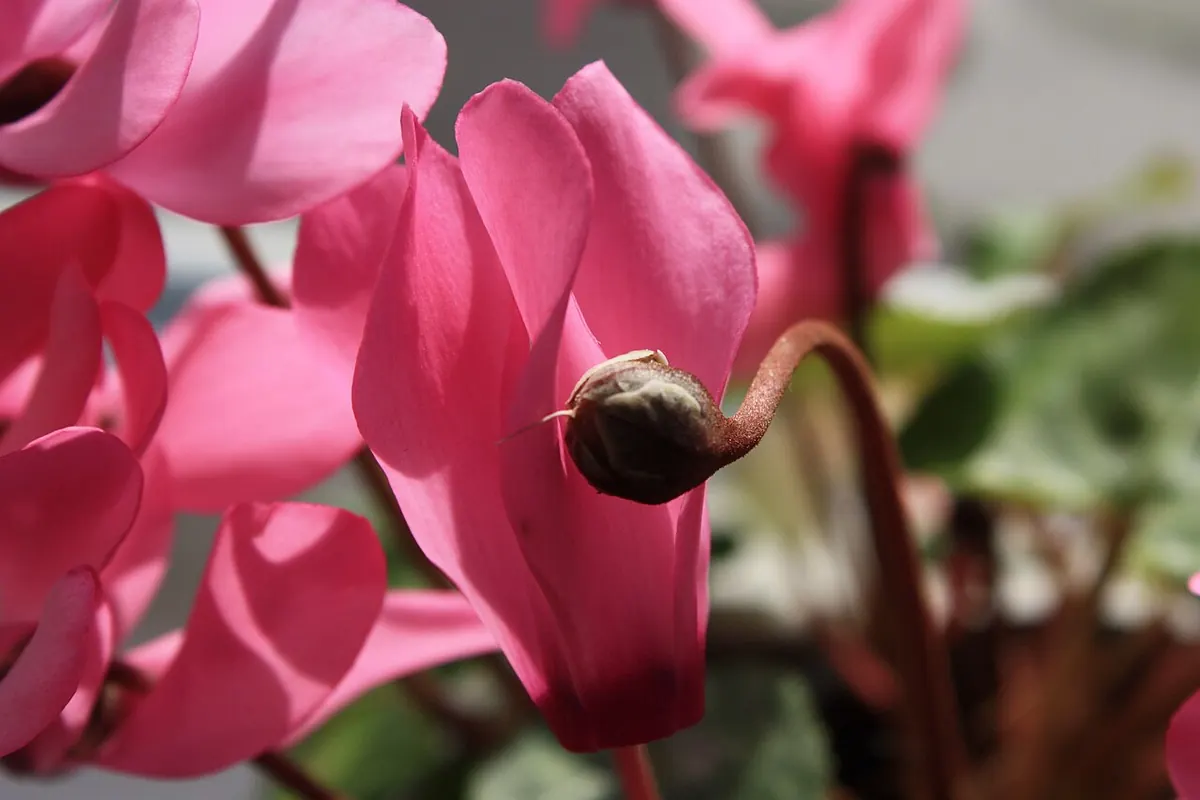
Then give it a cool, bright spot away from heat vents, radiators, and other hot, dry air. Clemson warns that heat vents dry the potting mix too quickly, and the RHS asks you to keep indoor cyclamen away from direct sunlight and heat sources. Colorado State University Extension prefers an east or north windowsill and notes that an east window with some morning light is ideal, but the leaves should not touch cold glass, which may freeze them. Wisconsin often uses an east window too, and says a south window can be better in a Wisconsin winter.
Light and Temperature for Cyclamen Care Indoors
Florist cyclamen wants it cooler than a typical heated living room. Clemson and Wisconsin both give ideal daytime temperatures of 60 to 65°F, with nights around 50°F. Clemson adds that if temperatures rise above 70°F, buds will fail to develop. Iowa State prefers a slightly cooler band of 50° to 60°F. CSU also gives 50 to 60°F. NC State recommends cool temperatures of 65°F and moderate humidity. The RHS asks for bright filtered light, moderate humidity, and a minimum winter temperature of 13 to 16°C (about 55 to 61°F), and it warns against draughts and hot, dry air.
Those figures are the sources’ own, not one blended range. Wisconsin also notes that today’s hybrids can be maintained over a wider temperature range and still perform well, but individual flowers and the bloom season last longer if the plant is kept cool. In short, a bright, cool room is a better match than a spot above a radiator.
How to Water a Cyclamen Without Rotting the Crown
Watering is the usual failure point. The tuber, sometimes called the corm or crown, sits at the soil surface and can rot if it stays wet. Clemson, NC State, and Wisconsin all say to water only when the potting mix feels dry on the surface, and to water along the edge of the pot or from below rather than onto the crown. Iowa State suggests checking the soil daily and waiting if it is still moist, and using warm, room-temperature water so the foliage is not damaged.
Water thoroughly when you do water, then do not leave the pot standing in a saucer of water. CSU says to wet the soil until some water drains, then empty the saucer after a 15-minute soak. Wisconsin describes the same bottom-watering habit: stand the pot in water for 15 minutes, then allow the mix to almost dry before watering again. The RHS Christmas guide says an occasional dry spell is less harmful than overwatering.
A long-spout watering can makes it easier to water at the pot edge and keep the crown dry. Surrounding notes here are about the tool type, not one exact product.

- Flexible watering options: This watering can features a detachable shower head that switches between a direct stream and a soft...
- Precision with long spout: This plant watering can features a long spout that reaches deep into pots and corners, delivering water...
- Right-size for daily watering: This small watering can holds 1.8L for several pots in one go, saving refill trips without being...
While the plant is in bloom, Wisconsin also asks for high humidity and moist, not soggy, soil. A tray of wet gravel or pebbles can help, provided the pot itself is not sitting in the water. Keep the plant away from warm drafts.

- What You Will Receive: the package comes with 2 packs of bonsai humidity trays, you can use them to hold bonsai tree, cactus...
- Wide Enough for Most Pots: the outer dimension of our drip trays for potted plants is about 7.8 x 5.5 inches, the internal size...
- Maintain Humidity: the planter saucers are designed to collect excess water seeping from the drainage holes at the bottom of the...
Feeding, Potting Mix, and Repotting
Iowa State recommends a dilute fertilizer every two weeks while the plant is in bloom. Wisconsin uses a low-nitrogen fertilizer, or a houseplant food for blooming plants, on the same every-two-weeks schedule when the plant is growing actively, and warns that too much fertilizer encourages soft, lush growth that is more prone to disease. The RHS also uses a low-nitrogen liquid fertilizer fortnightly while the plant is in growth. Clemson’s rebloom directions, which apply after new leaves appear in fall, use a monthly liquid houseplant fertilizer instead.
Many florist pots are meant to get the plant through one bloom. None of the sources used here require an immediate repot on the day you bring the plant home. If you do repot later, the RHS recommends a peat-free, loam-based mix and says the tops of the tubers should sit just above the soil surface. Iowa State also sets the top of the tuber slightly above the soil after a rest period. Wisconsin is more specific after summer dormancy: pot with the upper half of the tuber above the mix, in a well-drained potting mix, and begin watering again when new leaves form.
Cyclamen Care After Blooming and During Dormancy
To keep flowers coming for as long as the plant is able, remove spent blooms. Clemson, Wisconsin, CSU, and the RHS all describe the same motion: take the stem near the base and twist or pull it sharply so the whole stem comes away from the crown. Leaving a stub can lead to rot. CSU gives the same treatment for yellowing leaves during the bloom period.
How long a plant stays in bloom is not one agreed number. Clemson says that with proper care it may bloom for up to four weeks. Iowa State says several weeks. Wisconsin says up to three months. The RHS Christmas guide says several months, and that the plant can flower again in future years. Cool temperatures, even moisture, and regular deadheading are the shared ways to stretch the display.
When blooming ends, florist cyclamen follows a Mediterranean rhythm: growth in the cool, wet season, then a dry summer rest. Leaves yellow and drop as the tuber stores energy. Iowa State, Clemson, and NC State all note that many people discard the plant at this point, and that getting a compact, high-quality plant to rebloom well in the home is often difficult, usually because indoor light is too low. That is a fair choice. If you want to try for another year, follow one sourced method closely rather than mixing them, because the details are not identical.
- Iowa State would gradually cut back on water as the leaves die, remove the spent foliage, and give a rest of about six to eight weeks in late spring and early summer, in a cool (45° to 50°F), shaded place. In mid- to late summer, it would warm the plant to 50° to 65°F and begin watering again to encourage new growth.
- Wisconsin describes a two- to three-month dormancy beginning in late spring. Reduce watering and fertilizer as the leaves fade. A dormant plant may spend the summer outdoors if the mix is not left wet while the pot is leafless, and it must come back inside before the first frost. Another Wisconsin option is to withhold water after blooming, then store the bare tuber in dry vermiculite at about 50°F for six to 12 weeks before repotting.
- Clemson says to keep the soil from completely drying out during dormancy, hold the pot in a shady place until new leaves appear, then in mid-September move it to a bright, full-sun location, water thoroughly, and fertilize monthly, with nights at 50°F and days at 60 to 65°F. It says florist cyclamen can rebloom by mid-winter when light, moisture, and cool temperatures are right.
- The RHS plant profile says to reduce water after flowering and keep the tuber dry when dormant. The RHS Christmas guide instead says to continue careful watering and feeding until the leaves yellow, then reduce watering for the summer rest, and, as new growth appears, replace the top few centimetres (about half an inch) of compost and resume regular watering.
Notice that “keep the soil from completely drying out,” “keep dry when dormant,” and storing a bare tuber in dry vermiculite are different instructions. Do not blend them into one schedule, and do not treat yearly rebloom as a guaranteed result.
Common Cyclamen Problems
Yellow leaves can mean the plant is too wet, too dry, too hot, or too dim. Wisconsin lists all of those causes, and also notes that buds may blast or abort in hot, dry conditions or low light. Soft, limp foliage often means the plant needs water; a mushy crown or a pot that never dries usually means overwatering and possible tuber rot, which NC State flags as a result of wet crowns. Short bloom life in a warm room matches Clemson’s warning about temperatures above 70°F and heat vents.
Clemson, Wisconsin, and NC State say serious pests are uncommon, but aphids, mealybugs, spider mites, and thrips can appear. Plants with cyclamen mites are best discarded, because that pest is hard to control. The RHS also lists vine weevil on container plants, and diseases including cyclamen grey mould and black root rot. If a plant collapses at the crown, do not keep watering it on a fixed calendar; check the mix and the tuber instead.
Is Cyclamen Toxic to Cats and Dogs?
Yes. The ASPCA lists cyclamen (Cyclamen spp.), also called sowbread, in the family Primulaceae, as toxic to dogs, toxic to cats, and toxic to horses. The toxic principles are terpenoid saponins. The clinical signs on that page are salivation, vomiting, and diarrhea; following large ingestions of tubers, the record lists heart rhythm abnormalities, seizures, and death.
Keep the pot where pets cannot chew the leaves, flowers, or the tuber. If you think a pet has eaten any part of the plant, the ASPCA page says to call ASPCA Poison Control at (888) 426-4435 or contact your veterinarian as soon as possible. A consultation fee may apply. Absence from a different plant list would not have proved safety, and this species does have an ASPCA record. This article does not add unsourced advice about “safe” nips of leaves or flowers.
A Note on Hardy Cyclamen Outdoors
People who search for cyclamen care outdoors are often looking at a different plant. Hardy garden species such as ivy-leaved cyclamen (Cyclamen hederifolium) and Cyclamen coum are not florist cyclamen and do not share the same indoor holiday care. The RHS hardy cyclamen guide describes C. hederifolium as an autumn-flowering garden plant with ivy-like marbled leaves, and C. coum as a winter-flowering plant with pink or magenta blooms from January to March that can survive severe weather in UK gardens.
Outdoor hardiness is not one blended USDA range. The NC State genus page says C. hederifolium, C. cilicium, and C. coum can tolerate USDA Zones 4a to 8b, while C. persicum may range from 9a to 11b. The separate NC State page for C. hederifolium lists Zones 5a through 9b. Use the page for the species you actually have, and do not plant a florist cyclamen in the ground after Christmas unless you are in a frost-free or nearly frost-free climate that matches the sourced hardiness for C. persicum. Wisconsin’s summer-outdoors note applies to a potted, dormant florist plant that comes back inside before frost, not to planting it as a garden perennial.
Cyclamen Care FAQ
How long does a holiday cyclamen bloom?
It depends on the source and the conditions. Clemson gives up to four weeks, Iowa State several weeks, Wisconsin up to three months, and the RHS several months. A cool room, careful watering, and twisting off spent stems are the usual ways to get the longer end of that range.
Why are my cyclamen leaves turning yellow?
During the bloom season, yellow leaves can mean overwatering, underwatering, heat, or low light, as Wisconsin describes. After the plant has finished flowering, yellowing and leaf drop can also be the start of normal summer dormancy. Look at the calendar, the crown, and the feel of the soil before you decide which one you are seeing.
Can I plant a florist cyclamen outside after the holidays?
Not in most of the United States. Florist cyclamen is frost tender, and NC State lists it as winter hardy only in USDA Zones 9–11. In colder regions, keep it in a pot. Hardy C. hederifolium and C. coum are the outdoor species, and they are not a substitute plant for the one you just bought.
Should I throw the plant away when it fades?
You can. Iowa State, Clemson, and NC State all say many people do, because reblooming a compact plant in the home is often difficult. If you keep it, expect a summer rest and follow one of the sourced dormancy methods above rather than promising yourself a repeat display.
Other Holiday Houseplants
Florist cyclamen sits alongside other winter gift plants that also prefer careful indoor care. See our guides to poinsettia care, amaryllis care, how to grow paperwhites, and Norfolk Island pine care. For another winter-blooming houseplant, we also have Christmas cactus care.
A cool window and a dry crown will do more for a holiday cyclamen than a warm mantel. Once the last flowers fade, you can compost the pot or give the tuber a rest; either choice is in line with the sources.