

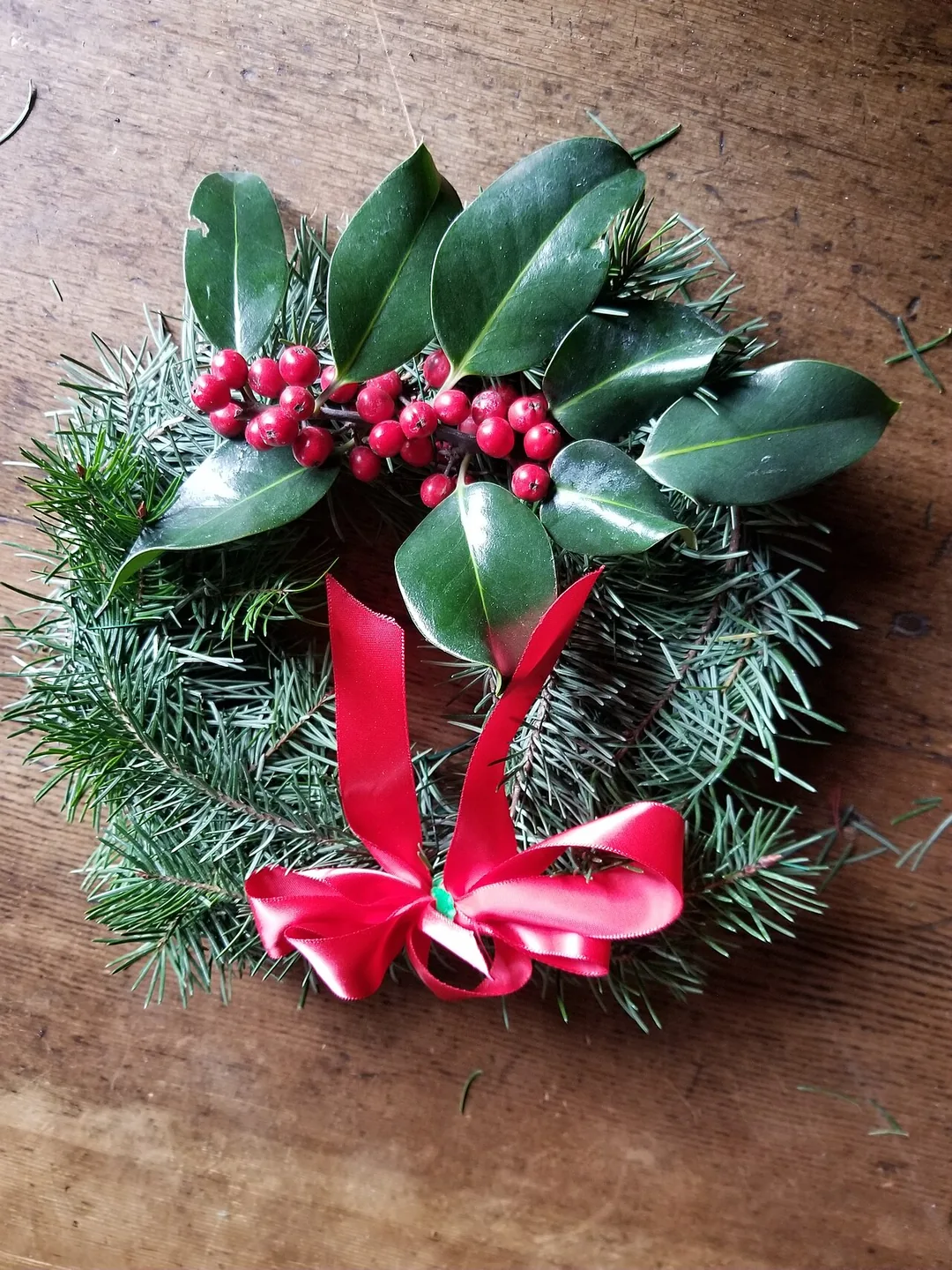
You can make a 20- to 24-inch (51- to 61-cm) fresh evergreen wreath in about 90 minutes with a 12-inch wire frame, about 2 lb (0.9 kg) of greens, and one spool of paddle wire, plus an overnight soak. That finished size is what most front doors want.
Key Takeaways
- A 12-inch box-style wire frame finished with 3- to 4-sprig bundles measures about 20 to 24 inches across.
- Fresh-cut wreaths typically last 7 to 10 days indoors; outdoors in cold weather they can hold from late November into January.
- Equal bundle size and tight wire keep a wreath round and intact; the number of green varieties matters far less.
What You Need
A single-faced wreath needs about half the greenery of a double-faced one, which is wired on both sides for the commercial trade. These amounts are rounded up a little so you are not short at the end.
| Item | Amount | Substitution |
|---|---|---|
| Box-style wire wreath frame, 12 in (30 cm) | 1 | 14 in (36 cm) for a wider door; a grapevine form works but sits flatter |
| Fresh evergreen sprigs: fir, pine, cedar, juniper, boxwood | About 2 lb (0.9 kg) | Any mix works; firs hold needles best indoors |
| Green paddle wire, 22 or 24 gauge | 1 spool | 24 gauge is easier on hands; 22 gauge holds heavier bundles |
| Wire-edged ribbon, 2½ in (6 cm) wide | 3 yd (2.7 m) | 1½ in (4 cm) ribbon makes a smaller bow; burlap is harder to shape |
| Holly sprigs | 3–5, about 6 in (15 cm) long | Juniper, false cypress, or pinecones |
| 24-gauge wire for decorations | 1 small spool | The same paddle wire works |
| Wreath hanger or picture hook | 1 | A nail plus a wire loop |
Tools: bypass pruners, wire cutters, garden gloves, an old towel, and paper or cardboard for the table. No glue gun, wreath machine, or foam form is needed; the wire frame does the holding.
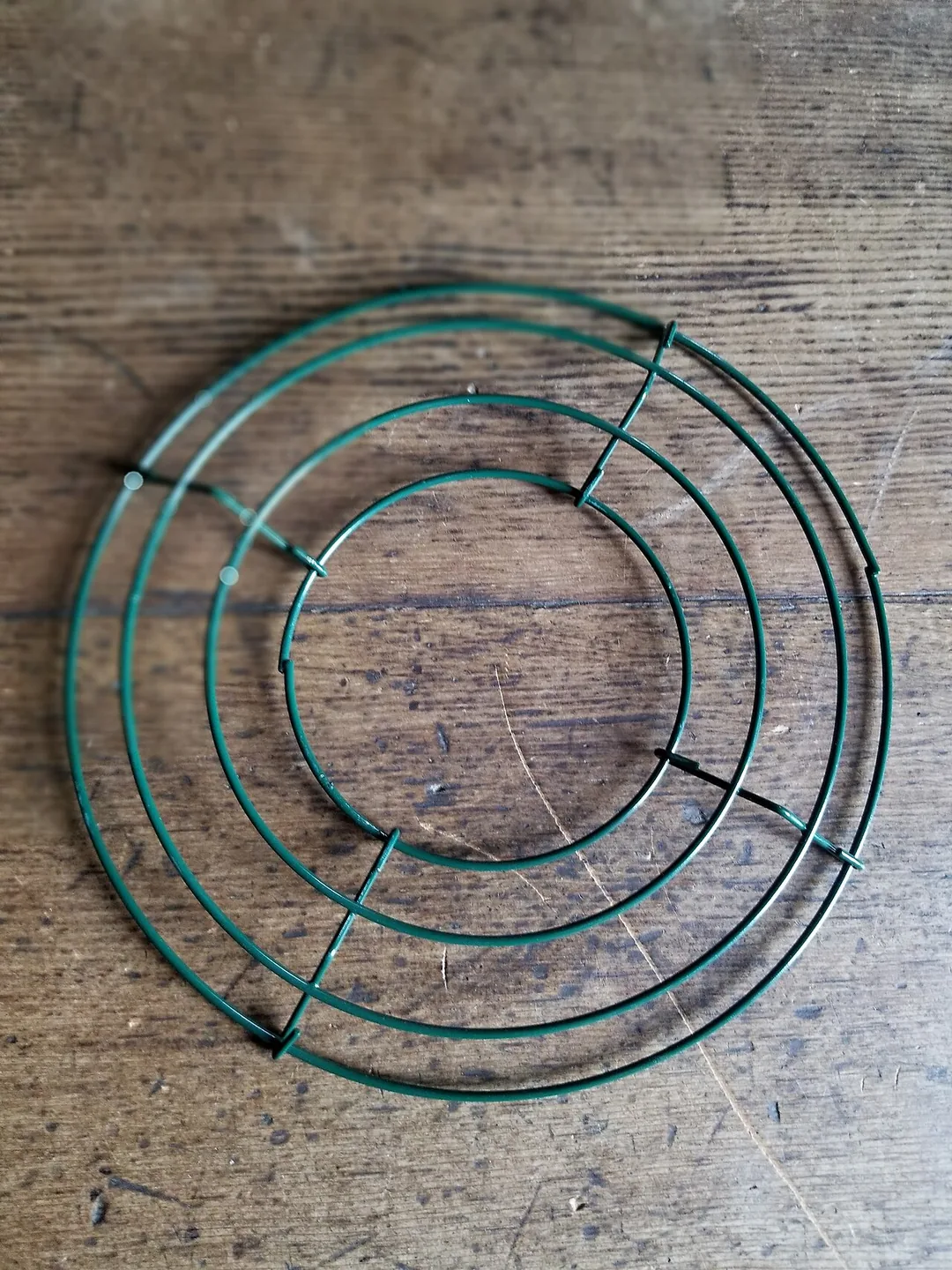
For the base of the wreath: a 12-inch box-style wire frame with several rails

- Heavy-duty Material: Made of quality iron wire, this 12-inch wreath frame feels solid and reliable. Multiple rings and firm welds...
- 24-Pack for Versatile Displays: Each pack includes 24 green wreath frames in a versatile 12-inch size, great for tables, mantels...
- Easy to Use: Simply wrap your favorite greenery, ribbon, mesh or ornaments around the round metal frame, or attach them with...
Before You Start: Size, Time, and Choosing Greens
Difficulty: confident beginner. The only skills needed are cutting stems cleanly with bypass pruners and pulling wire tight without letting it slip.
Time: 45 to 90 minutes of active work, longer the first time while you sort and trim greens. Add an overnight soak of 8 to 12 hours and about 30 minutes of draining. Total: one evening plus an afternoon.
Workspace: a covered table near a sink. Greens are sticky, and sap gets onto pruners, wire, and hands. Iowa State Extension suggests garden gloves for the needles and sap, and hand lotion before you start so the sap lifts off more easily afterward.
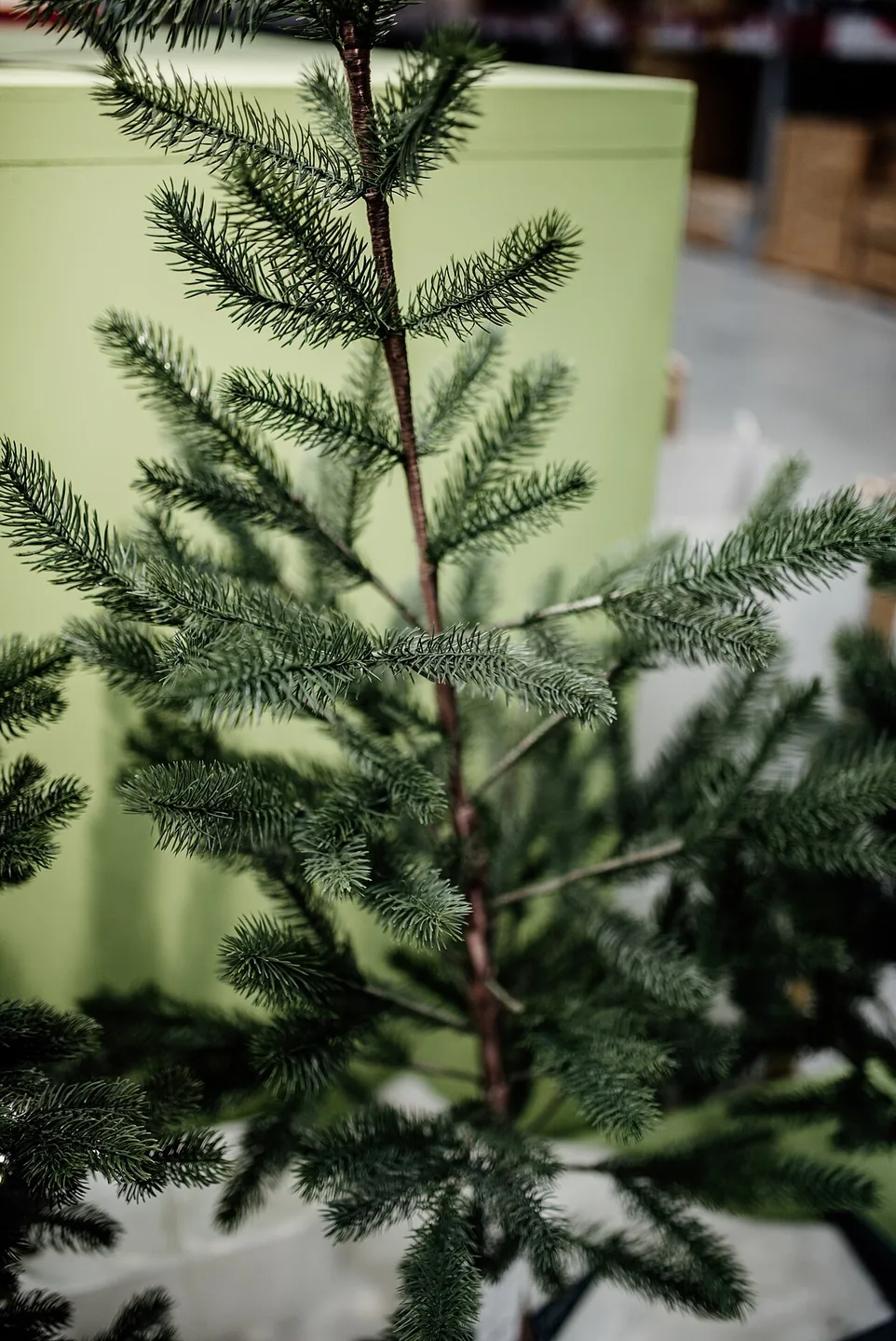
Choosing greens: bend a needle. Fresh material is pliable and smells strong; old material is brittle and drops needles. Clemson Extension rates firs as the best common green for a warm room, with good color and needle retention; spruce has the poorest retention and is better outdoors. If you cut from your garden, take a few branches from several spots, and use the trimmings from the bottom of a fresh Christmas tree.
01 of 08 — Soak the Greens Overnight
Fill a bucket or a bathtub with cool water and submerge the branches for 8 to 12 hours. Clemson Extension’s instruction is to immerse greenery in water overnight before arranging so the cuttings absorb the maximum amount of moisture. This is what separates a wreath that lasts a week from one that is crispy by day three, and it matters most for material that has been sitting in a garage or at a tree lot.
Lift the branches out, shake off the excess, and drain them on an old towel for about 30 minutes. If half the needles are already in the bucket, the material is too old to wire.
02 of 08 — Cut the Sprigs and Make One Reference Bundle
Cut the greens into 4- to 8-inch (10- to 20-cm) sections. Iowa State Extension uses that range for holiday wreaths: longer pieces make a shaggy, uneven wreath, and shorter ones leave gaps. Sort the cut pieces by species so you can mix them without hunting.
Build one bundle of three or four sprigs, layered with the fullest piece at the back, and set it on the table as your reference. Every bundle after that gets held against it. The most common beginner mistake is a bundle that grows as you work, which produces a wreath that is thick on one side and thin on the other.
03 of 08 — Anchor the Wire to the Frame
Lay the frame flat on the covered table. Unroll about 6 inches (15 cm) of paddle wire and wind the end several times around one of the frame’s welded joints, so the wire cannot pull free when you tension it. Leave the spool attached: you will wire the whole wreath from one continuous length and cut only at the end.
For tying on the bundles: a spool of green 22- or 24-gauge paddle wire

- Perfect for Wreath-Making and Decorations:This paddle wire is specifically designed for creating holiday wreaths,garlands,and...
- Strong Yet Flexible for Floral and Craft Projects: The green florist wire is flexible and strong,easily conforms to needed shapes...
- Wire for Christmas decoration:The green floral wire is ideal for blending into foliage,making it a go-to for decorating Christmas...
04 of 08 — Wire On the First Bundle
Set the reference bundle across the frame at the top, with the cut stem ends pointing the way you plan to travel. Hold the bundle against the frame and wrap the wire two or three times around both, about one-third to one-half of the way up from the stem ends. Pull each wrap tight.
Tension is the whole trick. Loose wire lets the bundle slide as the greens shrink, and the wreath loosens within a week. Wire pulled too tight crushes stems and snaps needles, which shows as a bald patch days later.
05 of 08 — Work Around the Frame in One Direction
Set the next bundle a couple of inches along the frame so it covers the stems and wire of the first, and wire it down the same way. Keep the tips angled in one direction around the circle, and keep matching each bundle to the reference. Add a little more greenery toward the outer rail if you want a fuller face.
Judge the work with the check Maine’s extension uses: compact enough to shake without falling apart, a clear hole in the middle, and no frame, wire, or broken stems showing. If the frame shows through, place the next bundles closer together, not bigger.
06 of 08 — Close the Circle and Tie Off
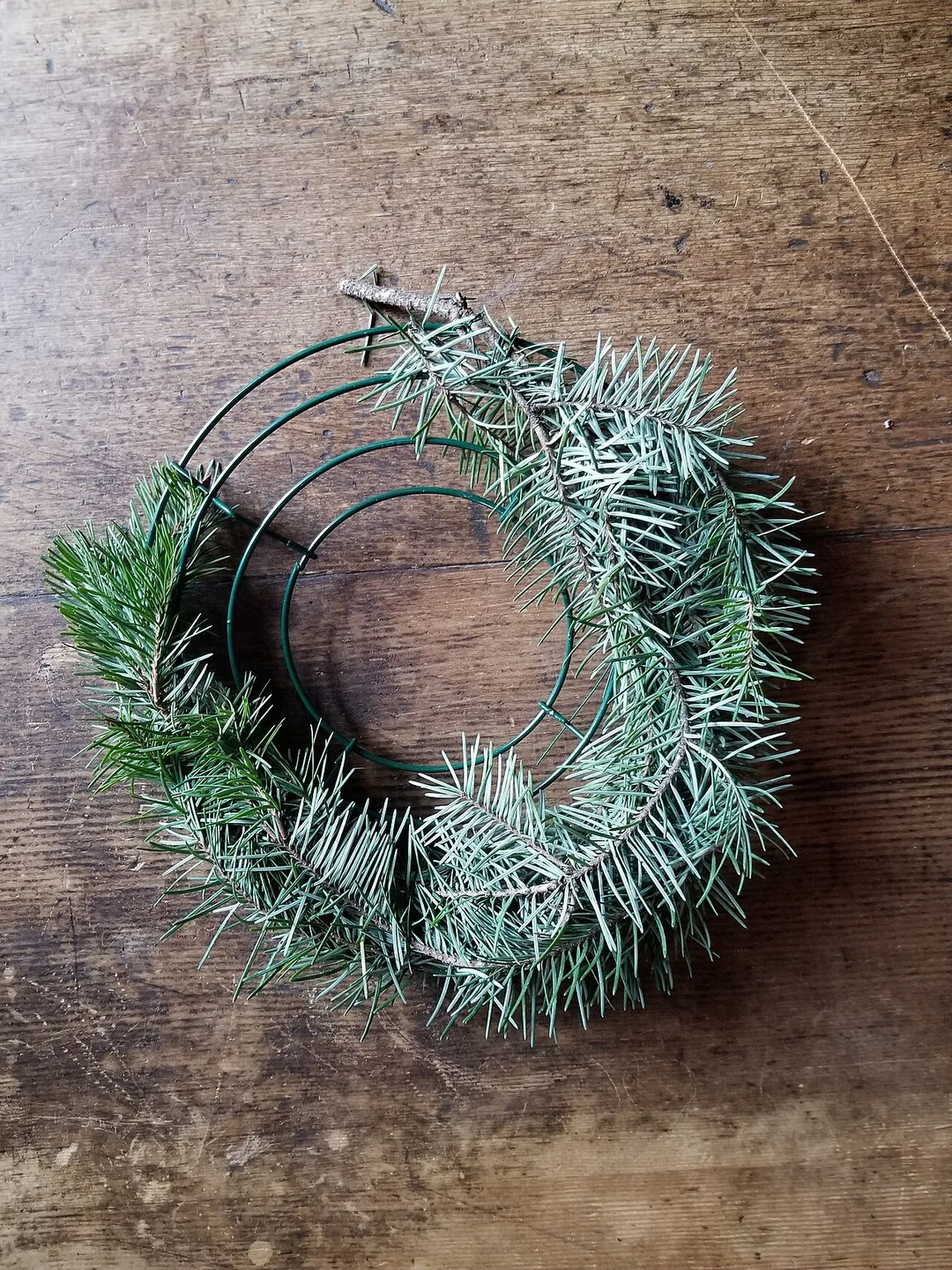
When you reach the start, lift the first bundle and slide the last one underneath it, then wire it down. That tucked ending hides the join. Cut the wire with about 6 inches (15 cm) to spare, twist the end around a rail on the back, and push the sharp end under the greens so it faces inward.
If a gap is left, nudge the neighboring bundles together or cover the spot with the bow. One dense patch in an otherwise even wreath reads as a lump.
07 of 08 — Add Holly and a Bow
Wire decorations on separately instead of weaving them into the greens. Twist a short piece of 24-gauge wire around the holly stem, push the wire ends through the wreath, and tie them to the frame at the back. Iowa State Extension gives the same instruction for cones, ornaments, and fruit: wire each item on its own and fasten it to the frame, not just the foliage.
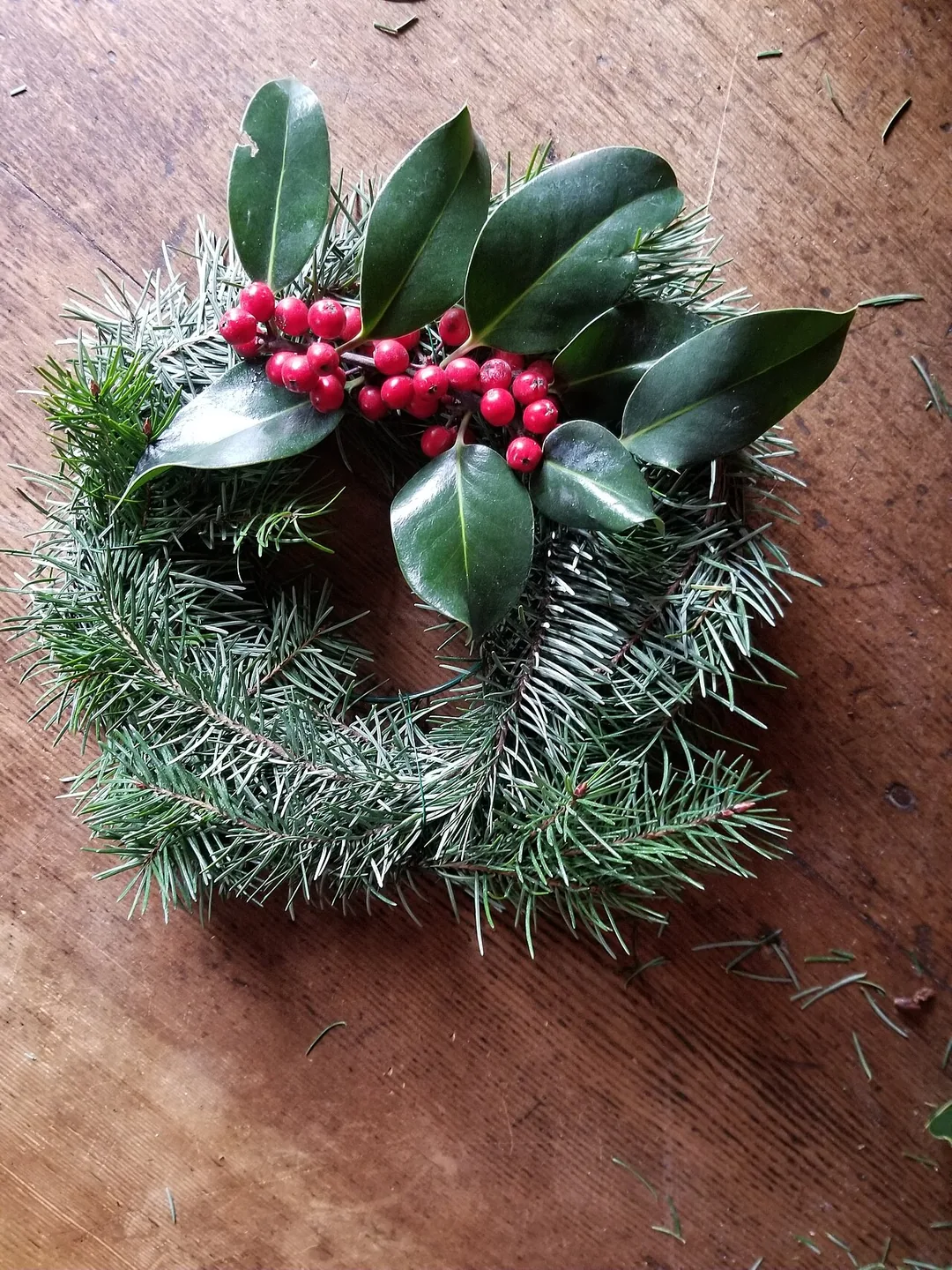
For the bow, use wire-edged ribbon so the loops hold their shape; 2½-inch (6-cm) ribbon and 3 yards (2.7 m) give a generous bow with tails. Wire the bow’s center to the frame, not the greenery, or it sags as the greens settle. Frosted pinecones and a smaller ribbon can go in after the bow is fixed.
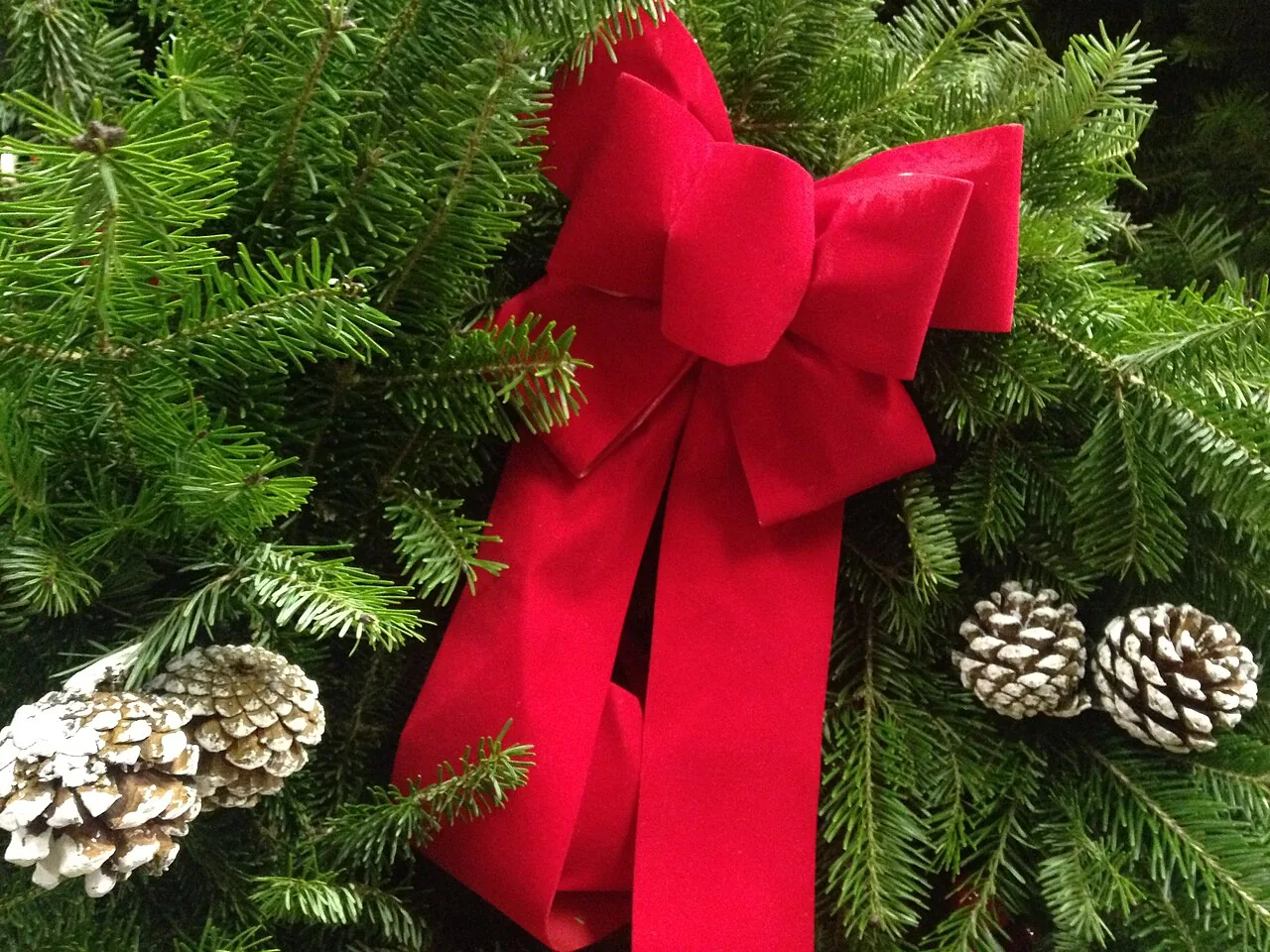
For a bow that keeps its shape: wire-edged ribbon about 2½ inches wide

- Christmas Style:Our Christmas ribbons featured classic Christmas elements, incl. Santa,snowflake,snowman,gingerbread man,black and...
- Size:Christmas ribbon wired measures 2.5 inch in width by 5 yards in length,30 yards in total.Enough holiday ribbon wired to meet...
- Quality material: The Christmas ribbons are made of quality polyester and linen with sewn wire edges,clear print with bright and...
08 of 08 — Make the Hanger and Hang It
Form a loop of wire around the top rail and set the wreath on a hook. Iowa State Extension suggests wiring the wreath to the hook so a door opened against the wind cannot knock it off. Stand back and check: a wreath that looks round on the table can hang crooked if the hanger is off-center.

How Long a Fresh Wreath Lasts
Indoors, expect 7 to 10 days from a fresh-cut wreath, according to Iowa State Extension, because heated air pulls moisture out of the needles quickly. Outdoors in a cold climate, the same guide says fresh wreaths and garlands last from late November into early January in Iowa, if not longer, as long as they are not hanging in wind.
Species changes the number. Clemson Extension says pines, firs, and cedars dry slowly and hold needles best in warm rooms, lasting several weeks with care; hemlock, spruce, and most broad-leaved evergreens do better outdoors. Boxwood is long lasting, and magnolia holds up even without water.
To stretch the time, hang the wreath in a cool room out of direct sun and away from heat vents, and mist it every few days. An anti-transpirant such as Wilt-Pruf can help if applied before hanging, following the label. Clemson warns not to use one on juniper berries, cedar, or blue spruce, because it damages the waxy coating that gives them color.
Care and Storage
Check the wreath every couple of days. Flexible needles are fine; brittle ones that snap, brown tips, or a shower of needles when you brush past mean it is drying, and the dry portions should come off. A fresh wreath resists flame far better than a dry one, but once it dries, it goes fast. Take it down rather than leave it up for looks.
If you make the wreath ahead of an event, keep it cool, damp, and well ventilated until the day before; Maine’s extension stores finished wreaths that way. For a wreath you want out only for a few occasions, Iowa State Extension suggests bagging it and keeping it in a cool garage between uses.
After the holidays, cut the wire at the back, lift off the greens, and compost them unless the wreath contains boxwood. Keep the frame, bow, and ornaments for next year; a good wire frame lasts decades. When January arrives, winter decor that does not depend on Christmas keeps the room from feeling bare.
Safety Notes
Fire. The U.S. Consumer Product Safety Commission says never to use lighted candles on a tree or near other evergreens, and to keep candles in non-flammable holders where they cannot be knocked over. Its guide adds that dry greens burn like tinder and that flames can flare out of control. Clemson Extension notes that a glass storm door in direct sun can reflect enough heat to burn a wreath hung behind it.
Berries and children. Holly, yew, mistletoe, and Jerusalem cherry all carry berries that are poisonous to small children and pets. Keep a berried wreath above reach, and pick up any berries that fall. If a child or pet eats berries, call poison control rather than waiting for symptoms.
Sap and needles. Wear gloves and long sleeves, especially with spruce and pine. Wash sap off with a pumice soap rather than solvent, and keep the pruners away from your face while cutting.
Tools and wire. Cut stems away from your body, and point wire cutters down and away so the cut end cannot spring toward your eyes. Turn every wire end inward and bury it in the greens; a 2-inch wire stub at eye height is an easy way to get hurt.
Boxwood blight. If your wreath includes boxwood, do not compost the trimmings. Iowa State Extension says boxwood wreaths can carry the blight fungus, which can spread from a discarded wreath to healthy shrubs. Bag them for the trash or burn them where local rules allow, and do not hang one near boxwood or pachysandra.
Questions People Ask
How many greens do I need for a 12-inch wreath?
About 2 lb (0.9 kg) of loose greens for a single-faced 12-inch wreath. Maine’s extension lists 3.5 to 4 lb of balsam tips for a double-faced 12-inch ring and notes that a single-faced wreath uses half the material.
Can I use branches cut from my Christmas tree?
Yes. The lower branches trimmed from a cut tree are a good source of wreath material, and Iowa State Extension recommends using them. Cut them fresh and soak them before wiring.
Why did my wreath come out lopsided?
Almost always because the bundles grew as you worked. Make one reference bundle at the start and hold every new bundle against it; also check that spacing around the frame is even.
How far ahead can I make it?
A day or two ahead is comfortable if you keep it cool and damp. A week ahead works outdoors in cold weather, but indoors the clock starts as soon as the wreath is in a heated room, so hang it late.
Do I need floral preservative in the soak?
No. Plain cool water is what the extension guidance calls for. An anti-transpirant spray after soaking is optional, and it is not suitable for cedar, juniper berries, or blue spruce.
Can I make the same wreath in another season?
Yes. The frame-and-bundle method is the same for a fall wreath or a Halloween wreath; only the greenery and decorations change. A smaller version also works as a table centerpiece, and the same look suits a 90s Christmas room.
If the wreath is the first thing on your door, the next job is the tree: our guide to decorating a Christmas tree step by step covers lights, ribbon, and ornaments in the order a designer would use. More Craft tutorials are on the category page.
Sources
- Iowa State University Extension and Outreach, “How to Create A Holiday Wreath”, reviewed November 2024.
- University of Maine Cooperative Extension, Bulletin #7012, “Making Balsam Fir Wreaths”, 2026.
- Clemson University Home & Garden Information Center, “Holiday Decorating With Fresh Greenery,” HGIC 1753, updated March 2023.
- U.S. Consumer Product Safety Commission, “Holiday Decoration Safety Tips” (CPSC-611).
- U.S. Consumer Product Safety Commission, “CPSC Announces Holiday Season Decorating Safety Tips”, 2005.