

Quick answer: red, green, and gold work together when one color dominates, one supports, and gold is used as a thin accent rather than a third block of color. The most reliable formula is roughly 70% green or red, 25% the other color, and 5% gold. Equal amounts of bright red and bright green compete with each other and make the whole manicure look busy.
Christmas is the one time of year when three strong colors are considered a palette rather than a mistake. The problem is that most festive manicures use them in the wrong proportions. A red nail, a green nail, and a gold nail on rotation looks like gift wrap. The same three colors arranged with a dominant shade look edited.
This guide covers the combinations that consistently look expensive, which shades suit which skin tones, and how finish changes the whole result. For the designs themselves, see our separate guide to 30 Christmas nail ideas.
Key takeaways
- Red, green and gold work at roughly 70% dominant, 25% supporting, 5% gold.
- Darken one color rather than pairing bright red with bright green.
- Match the undertone of the shade to your skin, not the season.
This guide draws on nail-care guidance from the American Academy of Dermatology, listed with links at the end.
The combinations at a glance
| Combination | Ratio | Best occasion |
|---|---|---|
| Forest green with a single red nail | 90 / 10 | Everyday December, office |
| True red with gold tips | 85 / 15 | Party, photographs |
| Emerald with gold pinstripes | 90 / 10 | Evening event |
| Burgundy and champagne | 80 / 20 | New Year’s Eve |
| Red plaid with gold thread | Pattern-led | Christmas Day |
| Cream, green, and gold dots | 60 / 30 / 10 | Daytime, family photos |
Why red and green need a referee
Red and green sit opposite each other on the color wheel, which makes them complementary. Complementary colors placed next to each other at full saturation increase each other’s apparent brightness, an effect that reads as festive at small scale and as vibrating at large scale. A whole hand of alternating bright red and bright green is the nail equivalent of a striped optical illusion.
Gold solves this because it behaves as a metallic neutral. It has warmth, so it sits comfortably beside both red and green, and because it reflects light rather than absorbing it, it separates the two colors instead of competing with them. That is why gold jewelry works with a red dress and a green dress, and why a gold line between red and green calms the pair immediately.
12 combinations that work, and why
01. Forest green with one red nail
Deep green on nine nails, true red on the ring finger. The green is dark enough to act as a neutral, so the single red reads as an accent rather than a clash. This is the most wearable Christmas palette on the list and the easiest to maintain as it grows out.
02. True red with gold tips
A blue-based red base with a thin champagne tip. The gold sits at the free edge where light hits it, so the manicure looks lit from within in photographs. Keep the tip line thin; a thick gold tip starts to look like costume jewelry.
03. Emerald with gold pinstripes
One or two hairline gold stripes down the center of each emerald nail. Emerald and yellow gold is a classic jewelry pairing, which is why it looks intentional on hands. Use striping tape if you want perfectly straight lines.
04. Red and green half-moon with a gold line
Red base, green half-circle at the cuticle, and a single gold line separating them. The gold line is doing the work here: without it, the two colors touch directly and the design looks heavier.
05. Burgundy and champagne gold
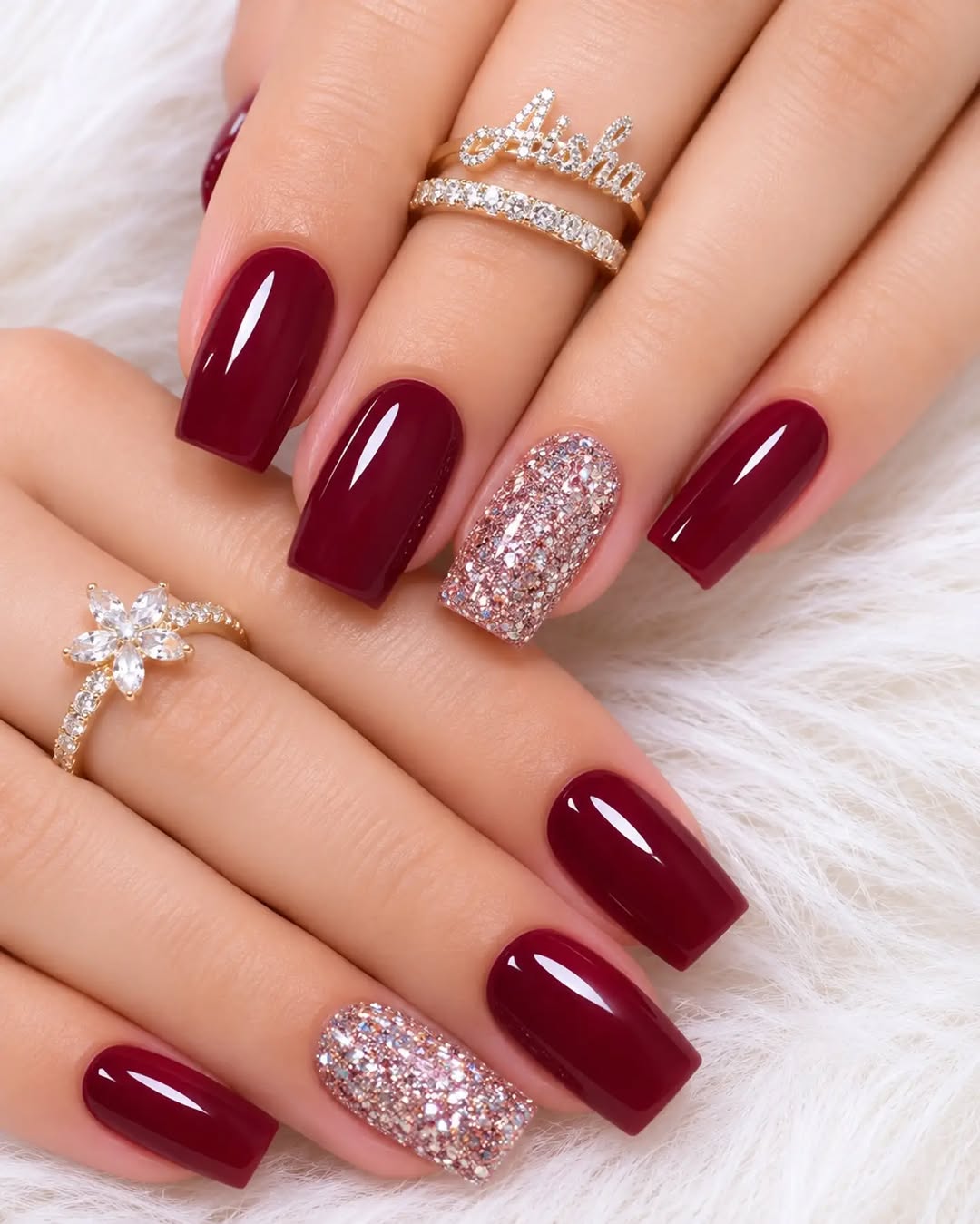
A deep wine red with champagne metallic on one or two nails. Burgundy is red pushed toward brown and purple, so it pairs with warm gold rather than bright yellow gold. This is the most elegant option for a New Year’s Eve table.
06. Emerald, white, and gold flakes
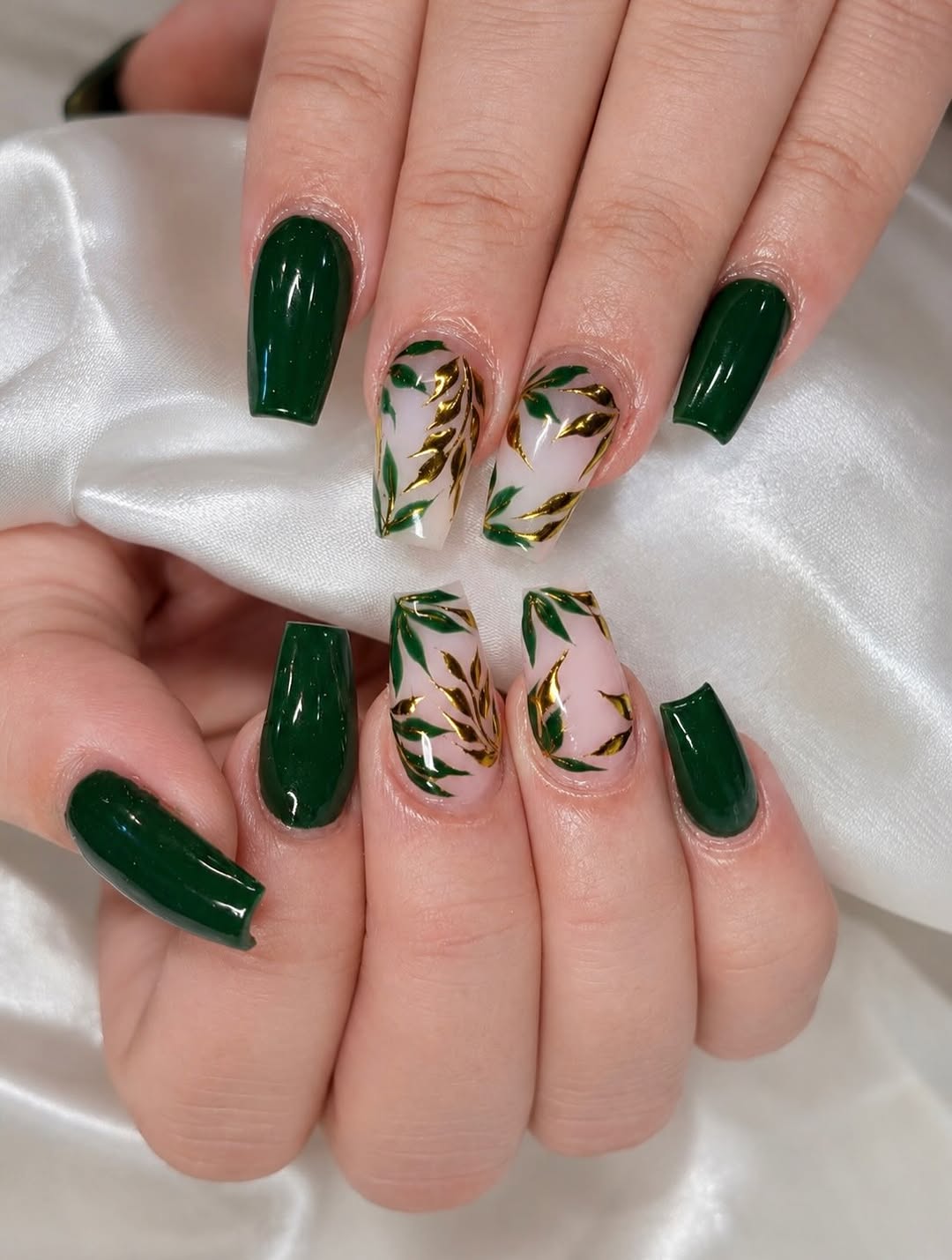
A deep green base with irregular gold leaf and a single white accent nail. The white gives the eye somewhere to rest, which is what makes three colors feel calm.
07. Red plaid with a gold thread
A tartan pattern built from a red base, black and white crossing lines, and one thin gold line. Because the pattern is busy by design, the gold reads as part of the weave rather than as decoration.
08. Matte green with a glossy red accent
Same two colors, two finishes. The contrast in shine does the work that a third color would otherwise do, and the result looks more modern than either color alone in gloss.
09. Oxblood, antique gold, and black
A dark red-brown base with antique gold and a black accent. This is the least literal Christmas palette here and the one most likely to be worn again in January.
10. Red glitter over deep green
Green base with a red glitter gradient at the tips. The glitter is sparse enough that the green still dominates, so the two colors blend rather than fight.
11. Cream and forest green
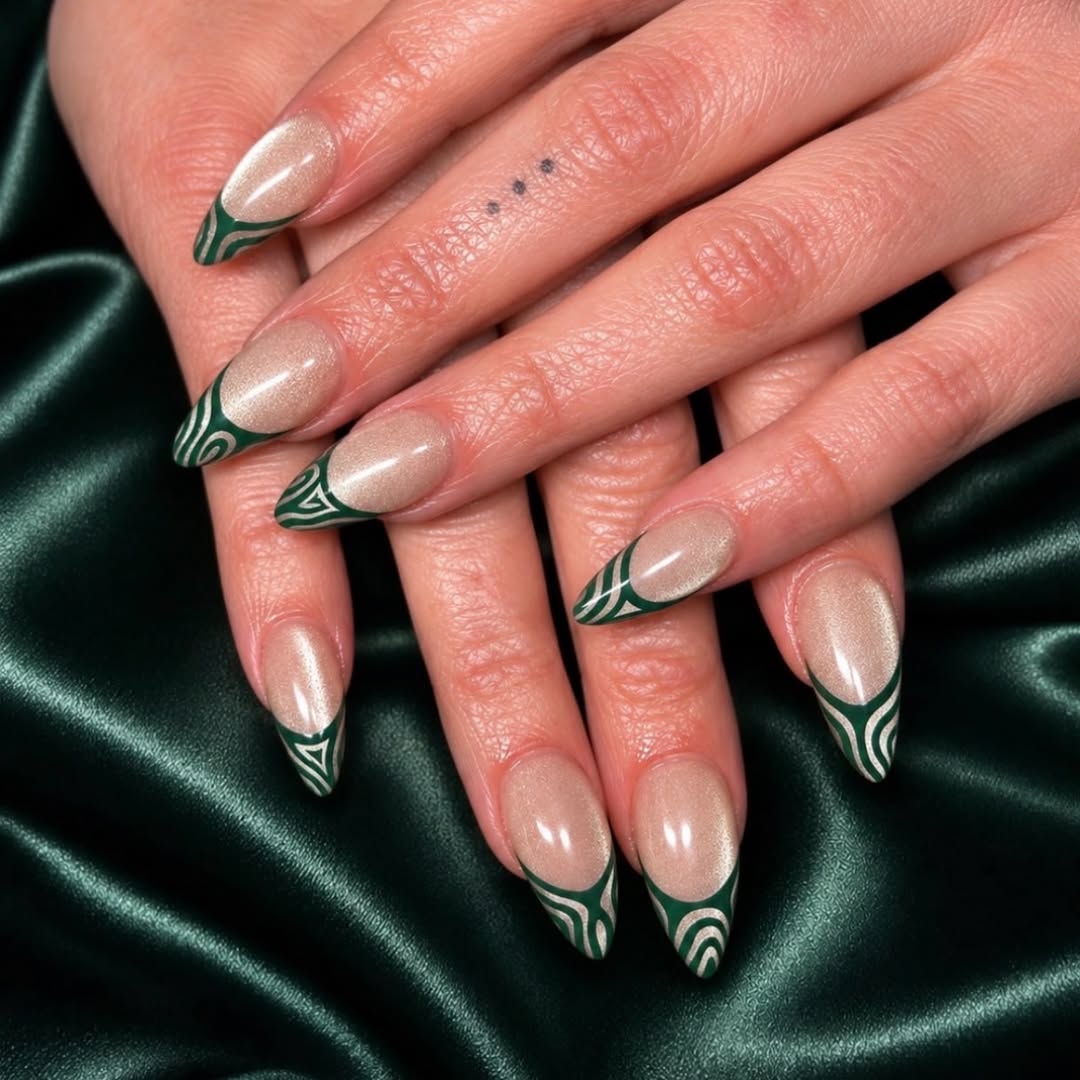
Cream as the base, forest green as a soft swirled French tip. Cream lightens the green and keeps the palette feeling more daytime than evening.
12. Monochrome red with gold hardware
Every nail red, with a single gold stud, line, or ring detail. One color plus one metal is the simplest possible festive palette and very difficult to get wrong.
Choosing shades for your skin tone
Red and green both exist in warm, cool, and neutral versions, and matching the undertone to your skin is more useful than matching the season.
- Cool undertones: blue-based reds, cherry, raspberry, emerald, and pine green. Pair with silver or white gold rather than yellow gold.
- Warm undertones: orange-reds, brick, tomato, olive, and moss green. Yellow gold looks natural here.
- Olive undertones: burgundy, oxblood, and deep forest green. Avoid bright orange-red, which can make olive skin look sallow.
- Deep skin tones: rich burgundy, emerald, sapphire-leaning green, and bronze gold. Highly saturated jewel tones show up beautifully; pastels and pale gold can wash out.
- Fair skin: berry reds, blue-red, and mid-depth green. Very pale mint green tends to disappear against fair skin.
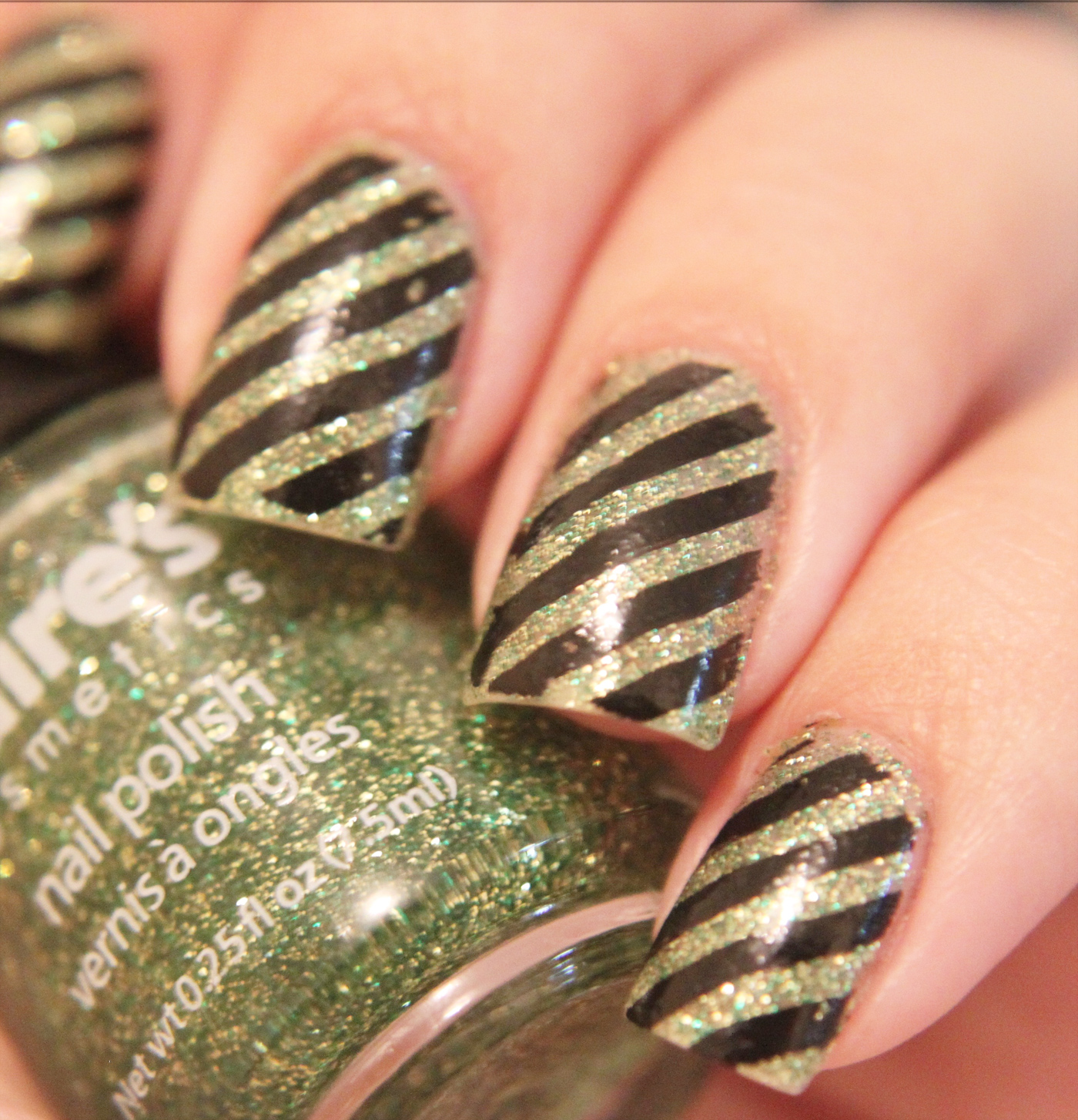
Finish changes the palette more than the color does
The same three shades can look cheap or expensive depending on finish. A few rules that hold up in practice:
- Use one metallic finish per hand. Gold glitter plus gold chrome plus gold foil is too much reflection.
- Matte deepens a color and makes it read as more expensive; it also shows every ridge, so prep matters.
- Gloss makes bright colors brighter, which is why a glossy bright green reads as more playful than a matte one.
- Shimmer in the base color is harder to combine with gold than a cream base. Cream plus metallic accent is the safer pairing.
How to test a palette before you commit
Paint one nail with each color and look at your hand from arm’s length in daylight, then again in the warm indoor light where the event will happen. Christmas colors shift dramatically under tungsten and fairy lights, and a red that looks blue in daylight can look orange indoors.
If you are choosing between two reds, put them side by side rather than on separate hands. Undertone differences are almost invisible in isolation and obvious in comparison. The same applies to greens: pine, emerald, and olive look similar on the bottle and completely different on the nail.
Mistakes that make festive colors look messy
- Equal thirds. Red, green, and gold in equal amounts has no focal point. Pick a dominant color.
- Neon green with true red. Both are high-saturation and cool-warm mismatched. Deepen one of them.
- Gold on every nail. Metallic reads as an accent. Repeated on all ten nails, it loses impact and shows wear.
- Too many finishes. Gloss, matte, chrome, and glitter on one hand looks like four different manicures.
- Ignoring the cuticle line. A messy cuticle edge ruins a good palette faster than a bad color choice.
One habit from the American Academy of Dermatology’s nail care guidance pays off here too: keep nails short and moisturize around the cuticles. Hydrated skin around the nail keeps that cuticle edge clean, which is what makes a two-color palette look finished [1].
Frequently asked questions
Is red and green too obvious for Christmas? Only when both are bright and used in equal amounts. Darken one, keep the other as an accent, and add a thin gold line, and the palette reads as considered rather than themed.
What gold goes with forest green? Yellow gold for warm skin and antique or bronze gold for deeper skin. Champagne gold is the most universally flattering if you only own one metallic.
Can I wear Christmas colors to the office? Yes, if you keep it to one color plus a neutral. Forest green on all ten nails, or a nude base with a single red accent, both pass in most workplaces.
Do these combinations work on short nails? They work better, because small nails suit one dominant color. Save the plaid and the three-color designs for longer nails where there is room for the pattern to read.
Sources
- American Academy of Dermatology, Nail care secrets.
Once Christmas is over, the same logic carries into January: keep one dominant shade and one thin metallic accent, and swap green for silver or black. The Nails archive collects the designs and care guides that pick up where this leaves off.